
Jev, the AI That Does Not Write: A Model That Returns Judgments Instead of Sentences
Opening: Does every AI task need a long answer?
When people hear “AI,” they usually picture a chatbot filling the screen with prose. That habit comes from large language models (LLMs) that answer questions in long sentences.
In day-to-day automation, a long sentence is often unnecessary. Questions like “Should this ticket go to refunds or shipping?” or “Is this transaction risky?” only need one short, definite answer.
TypeSafe AI built Jev for that use only. It does not write. It returns a judgment, quickly.
1. What is Jev?
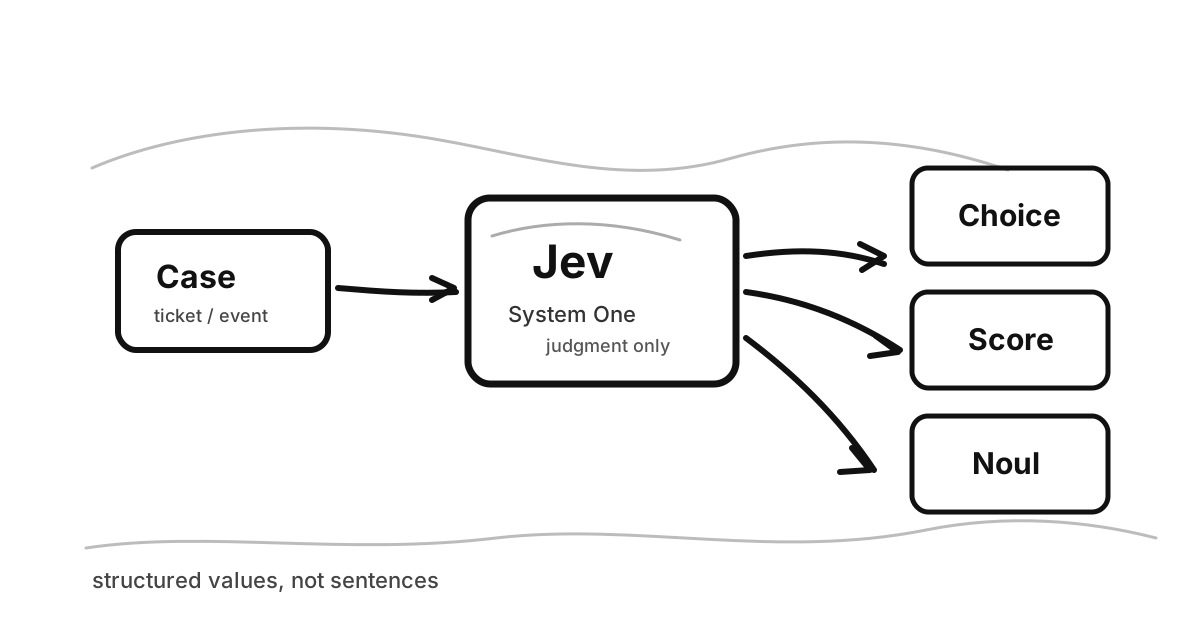
If a typical LLM is closer to picking words one by one until a long answer is finished, Jev is closer to looking at a situation and returning a fixed-shape value: a number, a score, or a probability.
TypeSafe AI calls Jev a System One Model. The name comes from psychologist Daniel Kahneman’s term for fast, intuitive thinking: System 1.
Three traits are highlighted.
- It does not write sentences. It does not draft blog posts or conversational replies. It returns values in a form a program can read immediately.
- It is fast. Guidance says results usually take 70–500 milliseconds (ms). That can be much faster than an existing LLM that spends several seconds on one answer.
- Input unit cost is described as low. The repeating input unit cost quoted on the company and gateway side is about $0.042 per 1 million input tokens. There is also a claim that output tokens are free, but the console or gateway billing card is the source of truth.
2. How does it work?
Programs already have if-else branches: “if this condition, do this; otherwise do that.” Jev is easiest to read as an AI that takes over that condition check. The question types (primitives) are three.
- Choice: Pick the best option among several. Example: does this customer message belong to refunds, shipping, or other?
- Score: Assign a score or level against a fixed rubric. Example: on a 1–5 scale, how risky is this document?
- Noul (true/false probability): Return the probability that a statement is true, as a value between 0 and 1. Example: how likely is it that this ticket is urgent?
Every judgment also comes with a confidence value. Low confidence means the model is not sure. A system can send only those cases to a person, or ask a larger model again.
3. Why does this matter?
If a chatbot already works well, why would a judgment-only model get attention? The reasons given are speed, stability, and cost.
It can be used in real-time services. A large LLM that takes several seconds per answer is hard to put on a payment screen or a customer-ticket router. If an answer arrives in a few hundred milliseconds, AI judgments can sit inside real-time apps, games, robot control, and bulk data classification.
The output shape does not break. Anyone who has asked an AI for JSON and then watched the format fail will recognize this. Jev is designed from the start to return only a fixed type, so that class of error does not appear.
The cost structure can change. Not every task needs an expensive top-tier model. Simple classification and branching can go to a fast, cheap model like Jev, and a larger model can be called only when deeper reasoning or writing is needed. Operating cost can fall as a result.
Closing: not a replacement, a part
Jev does not replace every other AI. Summarizing long text, writing a blog post, or drafting creative code is still something existing LLMs do much better.
The better fit is the classification and condition checks that software repeats constantly. The change Jev points to is this: AI does not have to be only a fluent conversation partner. It can also be a cheap, fast judgment part inside an app.
References
- TypeSafe AI official site: https://typesafe.ai/
- Related moonlang guide: https://moonlang.com/how-to-use-jev-typesafe-system-one-guide/
댓글
GitHub 계정으로 의견을 남길 수 있습니다. 댓글은 GitHub Discussions에 저장됩니다.