
A Philosophy of Software Design Part 1 - Complexity Is Design Debt
A Philosophy of Software Design treats software design less as architectural theater and more as the daily work of managing complexity. This part covers Preface, Chapter 1 Introduction, and Chapter 2 The Nature of Complexity. It uses only short key phrases from the source and turns the reading into summary, interpretation, and application.
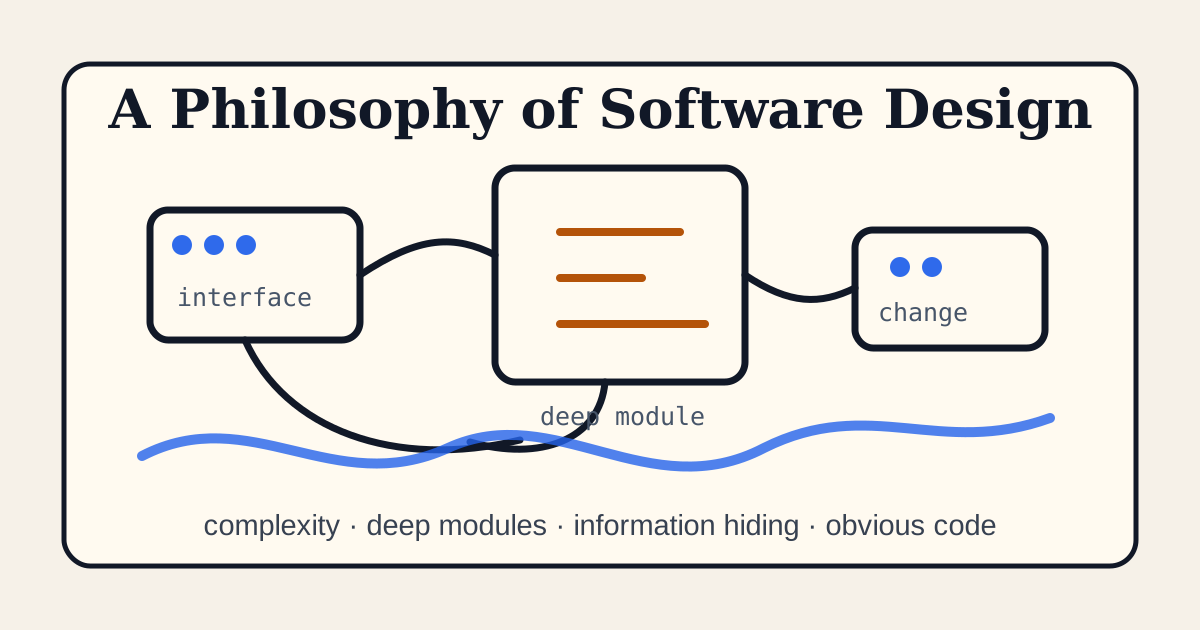
The guiding question is: What does good design reduce before it adds anything?
This is part 1 of a ten-part reading of A Philosophy of Software Design. The scope is Preface, Chapter 1 Introduction, and Chapter 2 The Nature of Complexity.
The operating principle remains: book notes are storage; insight cards are currency.
L0 · Entry
- Core sentence: The first standard of good design is not elegance in the abstract, but the power to reduce complexity.
- Why read this: As AI tools and automation make code faster to produce, I want sharper standards for code that remains understandable and changeable.
- Initial hypothesis: It is tempting to treat design as architecture diagrams or pattern selection. This section reframes it first as the work of reducing the mental burden on developers.
- Author context: John Ousterhout is a computer scientist known for work in operating systems, distributed systems, Tcl/Tk, and software design education at Stanford.
- Scope: Preface, Chapter 1 Introduction, and Chapter 2 The Nature of Complexity
L1 · Captures
“complexity”
This names the opponent the book keeps returning to. If complexity remains only a vague feeling, improvement has no direction. ^q01
“change amplification”
This captures the symptom where a small change spreads into many edits. I should first ask how far a change travels through my own code. ^q02
“cognitive load”
This measures design quality by the burden placed on the reader’s mind. Good code does not merely run; it is cheaper to understand. ^q03
This public note does not reproduce long source passages. It uses chapter-level concepts and short phrases as anchors, then provides transformative summary and commentary.
L2 · Map
| # | Range | Summary | Main claim |
|---|---|---|---|
| 1 | Introduction | Places complexity at the center of software design | Design is about long-term development productivity |
| 2 | Complexity defined | Complexity is the state where understanding and modification become difficult | It is closer to cognitive burden than code volume |
| 3 | Symptoms | Change amplification, cognitive load, and unknown unknowns appear | Naming symptoms gives refactoring a direction |
| 4 | Causes | Dependencies and obscurity grow complexity | Hidden dependencies are often more dangerous than visible connections |
Argument in one paragraph:
The first standard of good design is not elegance in the abstract, but the power to reduce complexity. It is tempting to treat design as architecture diagrams or pattern selection. This section reframes it first as the work of reducing the mental burden on developers. In practice, this moves review questions from “does it work?” toward “what must the next reader know in order to change it safely?” Design is not a separate ceremony; it is embedded in names, boundaries, exceptions, comments, layers, and performance choices.
L3 · Insight Cards
- A Philosophy of Software Design - I1.1 The first language of design is the symptom language of complexity
- A Philosophy of Software Design - I1.2 Change amplification is an early warning signal from the codebase
- A Philosophy of Software Design - I1.3 Cognitive load is a system design issue, not merely an individual skill issue
L4 · Production Board
- Blog draft: Part 1 as “Complexity Is Design Debt”
- Code review question: What does good design reduce before it adds anything?
- Insight card: The first language of design is the symptom language of complexity
L5 · Review
- Connections: This section connects with pragmatic responsibility, but shifts the emphasis from attitude to structure.
- Open questions:
- Where does this part’s red flag appear most clearly in my current codebase?
- What check would an AI coding agent need in order to apply this principle reliably?
- Final takeaway: Design is not decorating code; it is making the next change less disorienting.
댓글
GitHub 계정으로 의견을 남길 수 있습니다. 댓글은 GitHub Discussions에 저장됩니다.