
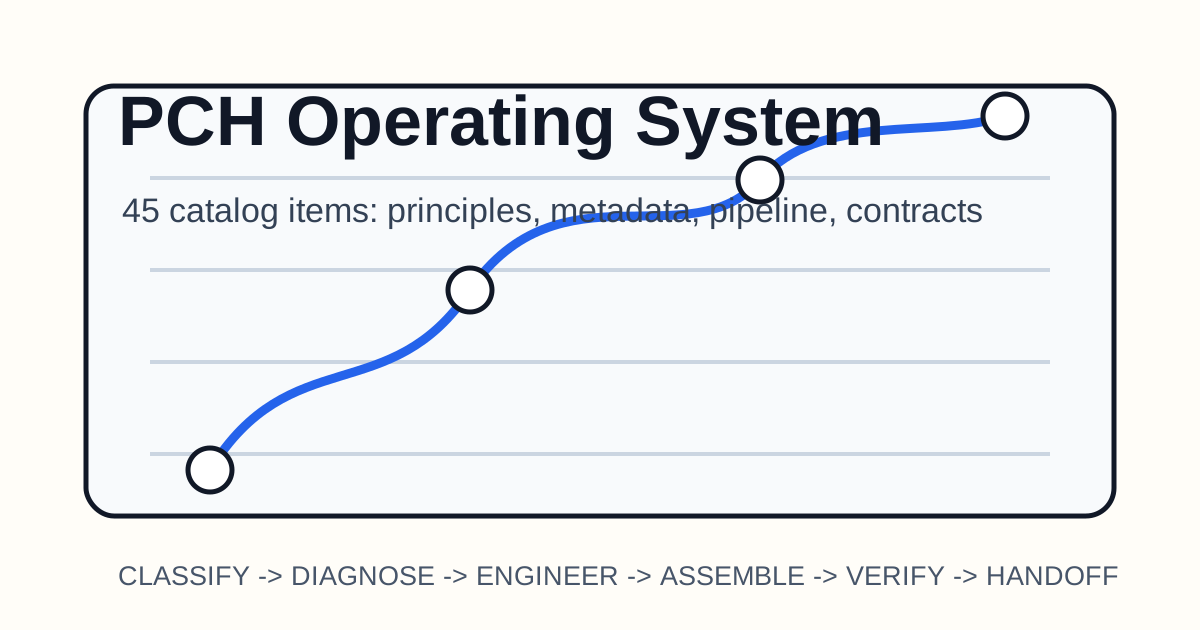
Reading the PCH-Optimizer prompt catalog again, I no longer see it as simply a prompt that improves prompts. It behaves more like a small operating system: it receives a prompt, classifies it, unfolds only the relevant layers, diagnoses it, assembles an upgrade, verifies the result, and hands it off.
This note covers 45 of the 115 catalog items. I am not publishing the original prompt as a public prompt dump. The public work here is to read the structure and extract blog-worthy ideas from it.
| Bundle | Items | Reading lens |
|---|---|---|
| Meta-System Prompt | 4 | The upgrader’s identity and mission |
| Operating Principle | 8 | The constitution behind every decision |
| Input Metadata | 7 | The input contract before the prompt |
| Target Type Classifier | 7 | The T1-T7 classifier |
| Layer Scope Rule | 4 | The switch that decides which layers open |
| Pipeline Stage | 9 | The execution path from CLASSIFY to HANDOFF |
| Output Contract | 6 | The section contract for final answers |
| Total | 45 | The operating layer |
Why an Operating System?
A common failure in prompt upgrading is to edit the sentence immediately: make it clearer, more detailed, more structured. PCH-Optimizer pauses before that. It first asks what kind of work this prompt is.
Is it a one-shot instruction? A few-shot extraction task? A grounded generation task? An agent prompt with tools? A subagent? A long-running harness? A creative persona prompt?
That question changes the whole upgrade. T1 prompts mostly need the Prompt layer. T3 prompts need Context and citation policy. T4 and T6 prompts may fail because of tools, state, termination criteria, or verification loops rather than wording.
An operating system’s first job is to place work into the right process. PCH-Optimizer does the same for prompts.
The Eight Principles Are the Kernel
The eight Operating Principle items come before technique. The goal is not to apply as many techniques as possible. The goal is to apply only what is needed without violating the deeper principles.
Four principles keep pulling me back.
| Principle | Meaning in prompt design |
|---|---|
| Context is finite and decays | Keep high-signal tokens instead of adding more |
| Right altitude | Avoid both brittle hardcoding and vague direction |
| Model does not equal harness | Separate wording failures from runtime failures |
| Verification over trust | Add pass/fail criteria instead of vibe checks |
Without principles, prompt improvement becomes decoration: XML, examples, checklists, bans, and extra sections. The answer may look more engineered while nobody knows which layer improved.
Principles ask not “how much can we add?” but “why exactly this much?”
Input Metadata Is the API in Front of the Prompt
PCH-Optimizer does not stop at the raw prompt. It asks for metadata such as target model, deployment surface, available tools, constraints, known failures, and success criteria.
That feels like API design. When a function lacks arguments, it starts guessing internally. Prompts do the same. Without the model type, it is hard to decide how much reasoning scaffold to include. Without the deployment surface, we do not know whether this is a one-shot reply, a RAG pipeline, or an agent loop.
A strong prompt upgrade begins with these questions.
1 | Where will this prompt run? |
Those five questions make a prompt much steadier.
T1-T7 Is a Blog Idea Generator
The Target Type Classifier is already a set of blog topics.
| Type | Blog question it opens |
|---|---|
| T1 one-shot instruction | How much structure does a one-line request need? |
| T2 few-shot extraction/classification | How many examples are enough? |
| T3 grounded generation | Are citation and hallucination control prompt work or context work? |
| T4 agent system prompt | Why does a tool-using model need a harness? |
| T5 subagent | Why can a narrower role be stronger? |
| T6 long-running harness | How does work survive beyond one context window? |
| T7 creative/persona prompt | How do voice and world become a contract? |
The type gives the angle. A T3 article naturally talks about grounding, retrieval, and citations. A T6 article talks about state artifacts and compaction. A T7 article talks about voice, world, and emotional pressure.
The Six Stages Also Write the Article
The PCH-Optimizer pipeline is CLASSIFY, DIAGNOSE, ENGINEER, ASSEMBLE, VERIFY, HANDOFF. That sequence works for prompt upgrading, but it also works for writing the blog series itself.
| Stage | Prompt upgrade | Blog writing equivalent |
|---|---|---|
| CLASSIFY | Identify type and scope | Decide the reader and problem type |
| DIAGNOSE | Find defects and risks | Show why the topic is hard |
| ENGINEER | Select techniques | Choose explanation devices and examples |
| ASSEMBLE | Produce a copyable artifact | Assemble a readable article |
| VERIFY | Attach tests and rubrics | Check claims, numbers, links, and images |
| HANDOFF | Log changes and next iteration | Leave the reader with the next question |
Turning the prompt catalog into blog posts followed the same pipeline. I classified the whole catalog, diagnosed which existing posts covered which parts, split the 115 items into three bundles, and assembled each bundle into an article.
Output Contracts Are Promises to the Reader
The six Output Contract items fix the answer order: classification, diagnosis, technique design, upgraded artifact, verification, and handoff. With that order, a model answer becomes a report instead of a blob.
Blog series need the same kind of promise.
- What part of the catalog this article covers
- Why this bundle matters
- What the PCH lens reveals
- Which prompt ideas can be reused
- What question the next post should answer
Repeat that structure and the series starts behaving like a harness. Each article is new, but the way of reading becomes familiar.
Prompt Idea from This Bundle
1 | You are a prompt operating-system designer. |
The point is sequence, not speed. Instead of rushing to the answer, the operating layer first decides where the work belongs. This is where prompt engineering starts moving from sentence craft into system design.
The next note looks at what this operating system diagnoses and how it earns the right to say an upgrade is actually better.
댓글
GitHub 계정으로 의견을 남길 수 있습니다. 댓글은 GitHub Discussions에 저장됩니다.