
A Philosophy of Software Design Part 3 - Information Hiding Protects Design Decisions
A Philosophy of Software Design treats software design less as architectural theater and more as the daily work of managing complexity. This part covers Chapter 5 Information Hiding (and Leakage) and Chapter 6 General-Purpose Modules are Deeper. It uses only short key phrases from the source and turns the reading into summary, interpretation, and application.
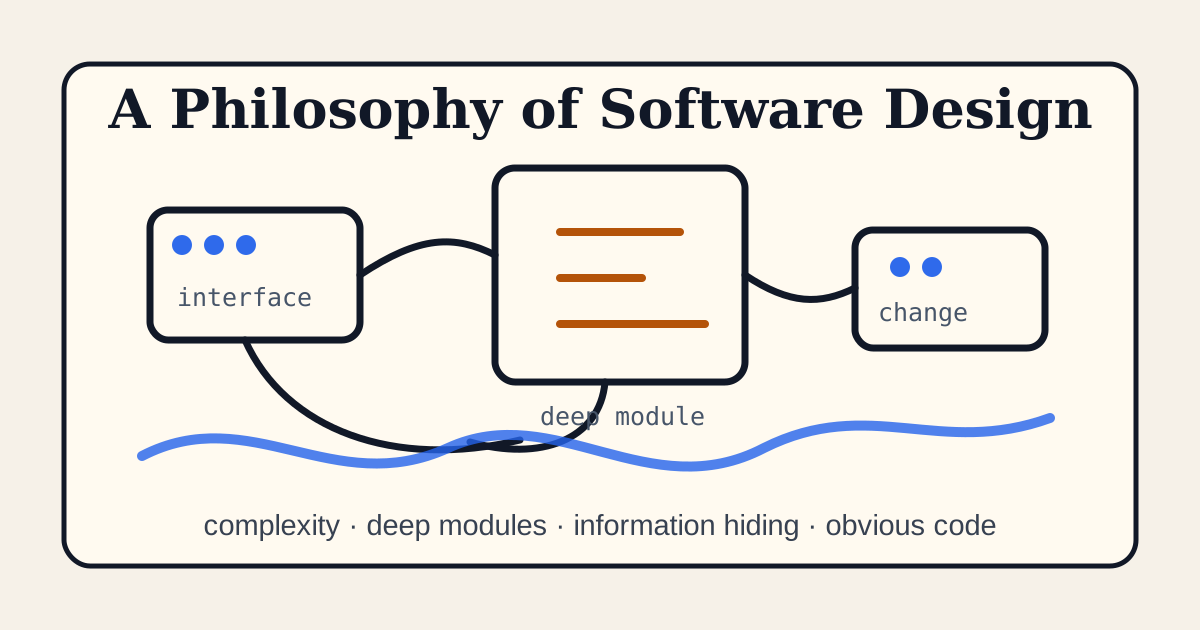
The guiding question is: What must a module hide in order to become deep?
This is part 3 of a ten-part reading of A Philosophy of Software Design. The scope is Chapter 5 Information Hiding (and Leakage) and Chapter 6 General-Purpose Modules are Deeper.
The operating principle remains: book notes are storage; insight cards are currency.
L0 · Entry
- Core sentence: Information hiding is not the act of concealing code; it is the act of concealing design decisions likely to change.
- Why read this: As AI tools and automation make code faster to produce, I want sharper standards for code that remains understandable and changeable.
- Initial hypothesis: If encapsulation is reduced to field access control, module boundaries become shallow. This section shows that the hidden thing is often a decision, not merely data.
- Author context: John Ousterhout is a computer scientist known for work in operating systems, distributed systems, Tcl/Tk, and software design education at Stanford.
- Scope: Chapter 5 Information Hiding (and Leakage) and Chapter 6 General-Purpose Modules are Deeper
L1 · Captures
“information hiding”
This principle moves change-prone decisions inside a module. If I do not ask what may change, I cannot know what to hide. ^q01
“information leakage”
This names the state where one decision spreads across several modules. Leakage expands the scope of edits and blurs the scope of tests. ^q02
“general-purpose”
This points toward APIs not tied too tightly to one caller. Generality is useful when it helps information hiding, not when it predicts imaginary futures. ^q03
This public note does not reproduce long source passages. It uses chapter-level concepts and short phrases as anchors, then provides transformative summary and commentary.
L2 · Map
| # | Range | Summary | Main claim |
|---|---|---|---|
| 1 | Information hiding | Keeps important decisions and details inside a module | Users can keep using the module while knowing less |
| 2 | Information leakage | Spreads the same knowledge across several locations | Change becomes expensive in proportion to leaked knowledge |
| 3 | Temporal decomposition | Splitting by task order can leak information | Process steps are not always good module boundaries |
| 4 | General-purpose API | A somewhat more general interface can make a module deeper | Caller-specific code often widens the interface |
| 5 | Over-generalization | Designing for imagined futures can add complexity | Generality must still be validated by present needs |
Argument in one paragraph:
Information hiding is not the act of concealing code; it is the act of concealing design decisions likely to change. If encapsulation is reduced to field access control, module boundaries become shallow. This section shows that the hidden thing is often a decision, not merely data. In practice, this moves review questions from “does it work?” toward “what must the next reader know in order to change it safely?” Design is not a separate ceremony; it is embedded in names, boundaries, exceptions, comments, layers, and performance choices.
L3 · Insight Cards
- A Philosophy of Software Design - I3.1 Information hiding asks which decision may change, not merely which field is private
- A Philosophy of Software Design - I3.2 Information leakage is duplicated knowledge, often quieter than duplicated code
- A Philosophy of Software Design - I3.3 Useful generality comes from simplifying the current interface, not from predicting every future
L4 · Production Board
- Blog draft: Part 3 as “Information Hiding Protects Design Decisions”
- Code review question: What must a module hide in order to become deep?
- Insight card: Information hiding asks which decision may change, not merely which field is private
L5 · Review
- Connections: This connects directly to Parnas-style module decomposition: decisions likely to change become candidates for module boundaries.
- Open questions:
- Where does this part’s red flag appear most clearly in my current codebase?
- What check would an AI coding agent need in order to apply this principle reliably?
- Final takeaway: A good module is not a wall around code; it is a workbench that gathers change-prone decisions in one place.
댓글
GitHub 계정으로 의견을 남길 수 있습니다. 댓글은 GitHub Discussions에 저장됩니다.