Cosmos Chapter 10 - At the Edge of Forever
This is part 10 of a 13-part reading of Carl Sagan’s Cosmos. The scope is Chapter 10, The Edge of Forever. The public note does not reproduce the source text. It uses chapter titles and short conceptual anchors to build summary, interpretation, and application.
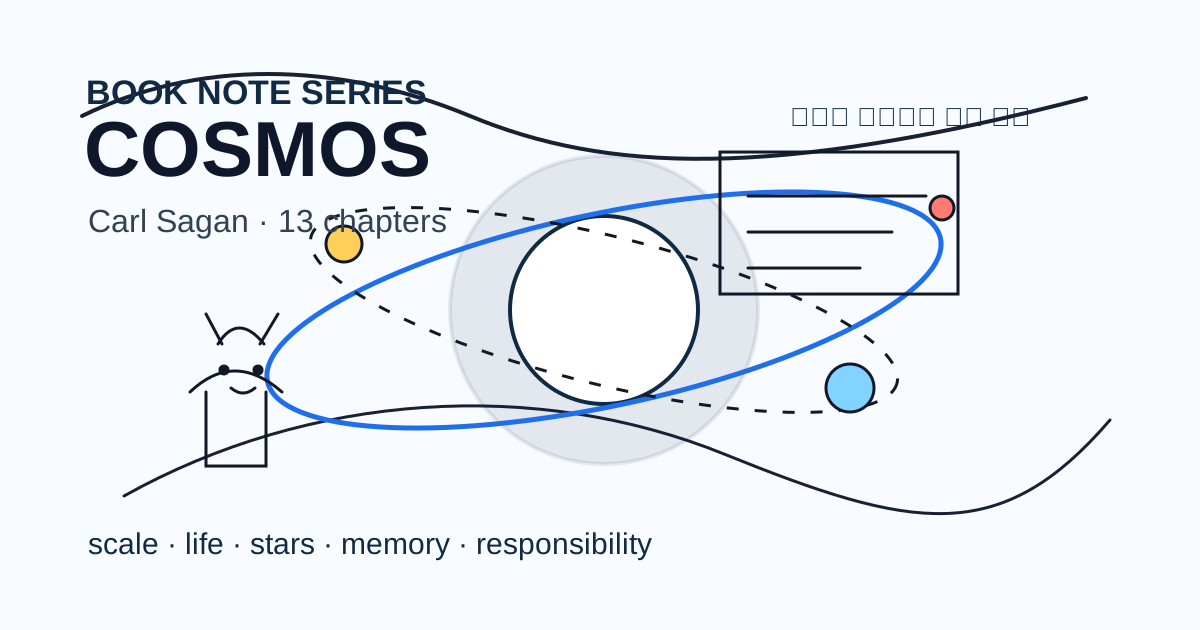
The guiding question is: Why does asking about the beginning of the universe change the human present?
This series treats book notes as storage and insight cards as currency. The source TXT and teacher DOCX remain private working material; the public article is a transformative reading note.
L0 · Entry
- Core sentence: Cosmology expands the question of origin without giving humanity the center seat.
- Why read this: I want to turn scientific knowledge into material for worldview, learning design, and better explanatory practice.
- Initial hypothesis: Questions of origin may sound philosophical or religious; this chapter shows how observation and theory reshape them scientifically.
- Author context: Carl Sagan connected planetary science, space exploration, and public science communication.
- Scope: Chapter 10, The Edge of Forever
L1 · Captures
“Big Bang”
This is used only as a short conceptual anchor for the chapter. ^q1001
This public note does not reproduce long passages, continuous scenes, or teacher-guide questions. It offers chapter-level summary, interpretation, and application in my own language.
L2 · Chapter Map
| # | Anchor | Role | Public use |
|---|---|---|---|
| 1 | Big Bang | opening concept | used as a short conceptual anchor only |
| 2 | cosmic background | scientific hinge | used as a short conceptual anchor only |
| 3 | expansion | connection term | used as a short conceptual anchor only |
Argument in one paragraph:
Cosmology expands the question of origin without giving humanity the center seat. This chapter is read here as a transformative summary rather than a substitute for the book. Its main claim is that cosmology does not center humans, but it gives human questions a larger background.
L3 · Insight Index
- Cosmos insight 10.1: origin questions change the background settings of a worldview
- Cosmos insight 10.2: small misconceptions can distort large theories
- Cosmos insight 10.3: understanding the universe means becoming comfortable without the center
L4 · Production Board
- Korean draft: 영원의 가장자리에서 우주는 기원과 미래를 동시에 묻는다
- Reviewed English version: At the Edge of Forever
- Teaching question: Why does asking about the beginning of the universe change the human present?
- Reusable insight: origin questions change the background settings of a worldview
L5 · Connections And Review
- Connection: This chapter matters less as a list of facts than as a training in how science changes the way we see.
- Action: Separate the most common misconception before explaining a large concept.
- Open questions:
- Why does asking about the beginning of the universe change the human present?
- What misconception would I need to prevent first if I turned this chapter into a student-facing explanation?
- Final takeaway: Cosmology expands the question of origin without giving humanity the center seat.
댓글
GitHub 계정으로 의견을 남길 수 있습니다. 댓글은 GitHub Discussions에 저장됩니다.