
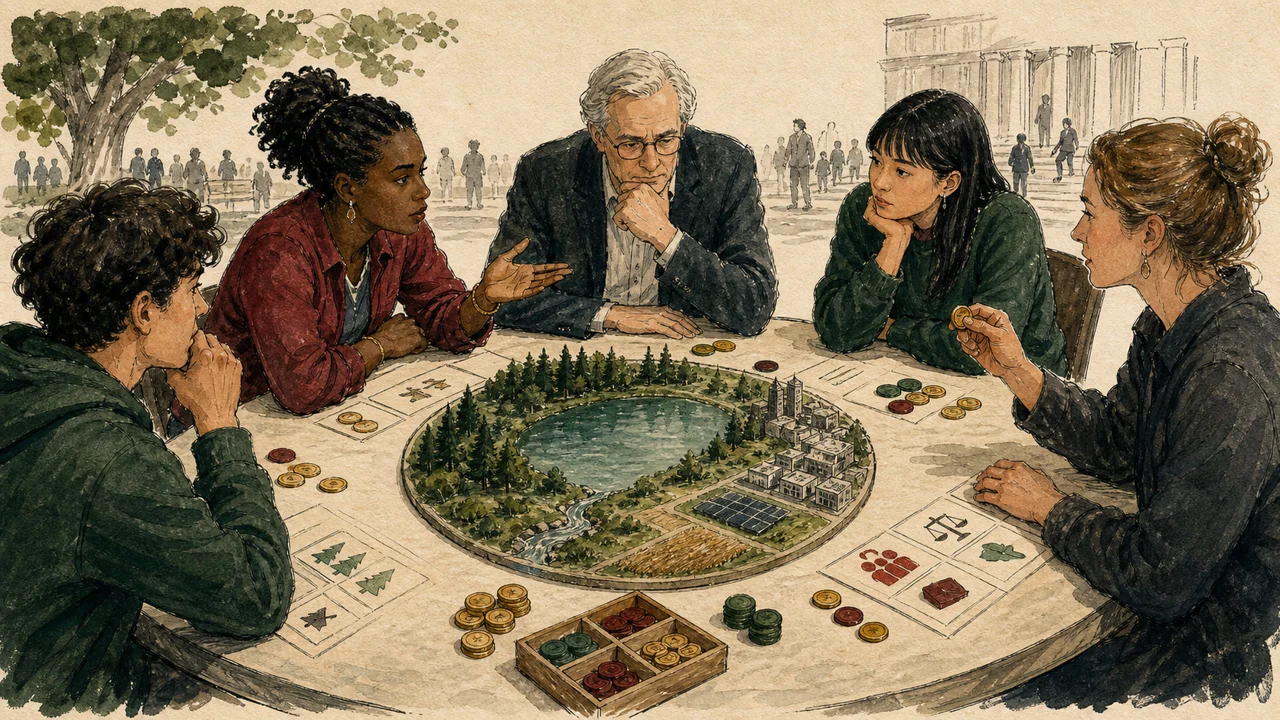
수능 영어에서 “공정성, 호혜성과 협력 게임” 주제는 용어 암기에서 끝나지 않고 낯선 지문의 논리를 빠르게 잡는 배경지식이 됩니다. 이 수업은 “왜 사람들은 작은 이익을 얻는 대신 불공정한 제안을 거절하며, 그 선택은 협력 규범을 어떻게 드러내는가”이라는 질문에서 출발해 영어 원문, 구조 지도, 수능형 추론 문제를 한 흐름으로 연결합니다.
학습 안내
| 항목 | 내용 |
|---|---|
| 추천 대상 | 고3 · CEFR B2-C1 |
| 배경지식 영역 | 사회·경제 |
| 핵심 질문 | 왜 사람들은 작은 이익을 얻는 대신 불공정한 제안을 거절하며, 그 선택은 협력 규범을 어떻게 드러내는가? |
| 학습 순서 | 개념 미리보기 → 영어 지문 듣기·읽기 → 구조 분석 → 수능형 문제 → 해설 |
| 예상 학습 시간 | 20 min |
Background Preview
최후통첩 게임은 금전적 이익만 최대화한다면 1달러라도 받아야 한다는 예측을 시험한다. 실제 사람들은 지나치게 불공정한 제안을 거절하여 자신도 손해를 본다. 이는 선택이 순수한 계산만이 아니라 공정성 규범, 상대의 의도, 앞으로의 호혜성에 의해 형성됨을 보여 준다.
중심 질문: 왜 사람들은 작은 이익을 얻는 대신 불공정한 제안을 거절하며, 그 선택은 협력 규범을 어떻게 드러내는가?
Read And Listen
People Care About Fairness [Ⅰ] The ultimatum game works like this: Two volunteers (who are otherwise strangers to each other) are told that they are going to play a game and could win a total of $100. Before they play, they learn the rules. The game begins with a coin toss, which is used to assign the volunteers to the roles of player A and player B. Player A’s job is to propose a division of the $100 prize between himself and the other player. After player A makes his proposal, player B decides whether to accept or reject it. If he accepts it, both players are paid according to the proposal. If player B rejects the proposal, both players walk away with nothing. In either case, the game then ends. Before proceeding, stop and think about what you would do in this situation. If you were player A, what division of the $100 would you propose? If you were player B, what proposals would you accept? [Ⅱ] Conventional economic theory assumes in this situation that people are rational wealth–maximizers. This assumption leads to a simple prediction: Player A should propose that he gets $99 and player B gets $1, and player B should accept the proposal. After all, once the proposal is made, player B is better off accepting it as long as he gets something out of it. Moreover, because player A knows that accepting the proposal is in player’s B interest, player A has no reason to offer him more than $1. In the language of game theory, the 99-1 split is the Nash equilibrium. [Ⅲ] Yet when experimental economists ask people to play the ultimatum game, the results are very different from this prediction. People in the role of player B usually reject proposals that give them only $1 or a similarly small account. Knowing this, people in the role of player A usually propose giving player B much more than $1. Some people will offer a 50-50 split, but it is more common for player A to propose giving player B an amount such as $30 or $40, keeping the larger share for himself. In this case, player B usually accepts the proposal. What’s going on here? The natural interpretation is that people are driven in part by some innate sense of fairness. A 99-1 split seems so wildly unfair to many people that they reject it, even to their own detriment. By contrast, a 70-30 split is still unfair, but it is not so unfair that it induces people to abandon their normal self–interest.
Shadowing Focus
- The game begins with a coin toss, which is used to assign the volunteers to the roles of player A and player B.
- If player B rejects the proposal, both players walk away with nothing.
- Conventional economic theory assumes in this situation that people are rational wealth–maximizers.
- In the language of game theory, the 99-1 split is the Nash equilibrium.
- In this case, player B usually accepts the proposal.
Structure Map
핵심 구조
| 요소 | 내용 |
|---|---|
| Topic | 최후통첩 게임에서 합리적 이익 계산과 공정성 규범의 충돌 |
| Thesis | 사람은 부를 극대화하는 계산뿐 아니라 타고난 공정성 감각에 따라 제안을 평가한다. |
| Evidence | 이론상 99-1 분할이 균형이지만 실제 응답자는 극단적으로 낮은 몫을 거절하고 제안자는 30~50달러를 제시한다. |
| Contrast | 금전적 자기 이익을 지키는 수락과 불공정을 제재하는 거절이 대조된다. |
| Concession | 70-30처럼 불공정해도 정도가 덜하면 정상적 자기 이익 때문에 수락될 수 있다. |
| Conclusion | 공정성은 개인이 비용을 감수하면서도 협력 규범 위반을 제재하게 만든다. |
문단별 수사 기능
- [Ⅰ] 규칙 설정: 두 참가자의 역할과 수락·거절의 결과를 설명한다.
- [Ⅱ] 이론적 예측: 합리적 부의 극대화가 99-1 분할을 예측함을 보인다.
- [Ⅲ] 경험적 반전: 실제 행동이 예측과 다르며 공정성 감각이 원인임을 해석한다.
B2-C1 어휘와 구문
- wealth-maximizer: 부를 극대화하는 행위자
- proposal: 분배 제안
- Nash equilibrium: 내시 균형
- to one’s detriment: 자신에게 손해가 되도록
- innate: 타고난
- induce A to do: A가 ~하도록 유발하다
- Although A, B: A를 인정하면서도 B를 중심 주장으로 제시하는 양보 구조다.
- The more A, the more B: A의 변화에 따라 B가 함께 변하는 비례 관계를 나타낸다.
CSAT Challenge
1. 빈칸 추론
다음 글의 빈칸에 들어갈 말로 가장 적절한 것을 고르시오.
A 99-1 split seems so wildly unfair to many people that they reject it, even ( ).
- when the proposer withdraws it
- after both players are paid
- to their own detriment
- because it maximizes joint wealth
- when fairness is irrelevant
2. 문장 삽입
주어진 문장이 들어가기에 가장 적절한 곳을 고르시오.
Yet when experimental economists ask people to play the ultimatum game, the results are very different from this prediction.
Conventional theory treats both players as rational wealth-maximizers. ( ① ) It therefore predicts that A will offer one dollar and B will accept it. ( ② ) The 99-1 split is described as the Nash equilibrium. ( ③ ) Responders commonly reject one-dollar offers. ( ④ ) Proposers consequently tend to offer thirty or forty dollars. ( ⑤ )
- ①
- ②
- ③
- ④
- ⑤
3. 함축 의미 추론
밑줄 친 “people are driven in part by some innate sense of fairness”가 의미하는 바로 가장 적절한 것을 고르시오.
- 사람은 모든 분배에서 정확히 같은 몫만 받아들인다.
- 금전적 이익 외에도 공정성 규범이 선택에 영향을 준다.
- 게임 규칙을 이해하지 못해 낮은 제안을 거절한다.
- 타인의 수입을 늘리기 위해 자기 몫을 항상 포기한다.
- 경제 이론은 실제 행동을 완벽하게 예측한다.
Answer Lab
정답과 해설 보기
1. 빈칸 추론: 정답 ③
근거: 지문의 핵심 인과와 결론을 그대로 완성하는 선택지는 3번이다. 빈칸 앞뒤의 논리 표지와 사람은 부를 극대화하는 계산뿐 아니라 타고난 공정성 감각에 따라 제안을 평가한다.라는 중심 주장을 함께 보존한다.
오답 분석: ①·②는 지문에 없는 조건을 더하거나 논리 방향을 바꾼다. ④·⑤는 핵심 개념의 효과를 과장하거나 반대로 서술한다.
교사 설명: 빈칸은 개별 사례보다 필자가 일반화한 문장을 우선 확인한다. 선택지가 원문의 주체, 방향, 강도를 모두 유지하는지 검토해야 한다.
2. 문장 삽입: 정답 ③
근거: 주어진 문장은 앞 내용의 결과를 받아 다음 설명으로 전환한다. 3 위치에서만 앞 문장의 정보가 이미 마련되고 뒤 문장의 지시 대상과 논리 흐름이 자연스럽게 이어진다.
오답 분석: 앞쪽 위치들은 필요한 배경이나 대조 항이 아직 제시되지 않았다. 뒤쪽 위치들은 원인과 결과 또는 일반화와 사례 사이의 결속을 끊는다.
교사 설명: 접속 표현뿐 아니라 문단의 수사 단계인 설정 → 근거 → 해석을 확인하면 위치를 안정적으로 결정할 수 있다.
3. 함축 의미 추론: 정답 ②
근거: 표현의 직전·직후 설명을 바꾸어 말하면 2번과 같다. 이는 사람은 부를 극대화하는 계산뿐 아니라 타고난 공정성 감각에 따라 제안을 평가한다.
오답 분석: 나머지 선택지는 행위의 방향을 뒤집거나, 지문이 제한적으로 말한 현상을 언제나 성립하는 절대 명제로 바꾼다.
교사 설명: 함축 의미는 표현 자체의 사전적 뜻보다 문맥에서 맡은 기능을 묻는다. 같은 단락의 사례와 결론에 동시에 들어맞는 해석을 고른다.
Knowledge Links
관련 주제
- 공공재, 무임승차와 공유지 거버넌스 | Public Goods, Free Riders, and Commons Governance: 개인의 기여와 집단 협력 규범을 확장한다.
- 이타성과 도움 행동 | Altruism and Helping Behavior: 자기 비용을 감수하는 행동의 다른 동기를 비교한다.
- 전망이론, 손실회피와 넛지 | Prospect Theory, Loss Aversion, and Nudges: 표준 합리성에서 벗어나는 선택 패턴을 연결한다.
이전 주제: 방관자 효과와 다원적 무지 | Bystander Effect and Pluralistic Ignorance
다음 주제: 이타성과 도움 행동 | Altruism and Helping Behavior
자주 묻는 질문
“공정성, 호혜성과 협력 게임” 주제는 수능 영어에서 어떻게 활용되나요?
“왜 사람들은 작은 이익을 얻는 대신 불공정한 제안을 거절하며, 그 선택은 협력 규범을 어떻게 드러내는가”에 답할 때는 원인과 결과, 대조, 사례, 함축 의미 속에서 공정성, 호혜성과 협력 게임의 논리를 따라가야 합니다. 개념명보다 공정성, 호혜성과 협력 게임 글의 필자가 어떤 근거로 결론에 도달하는지 표시하세요.
Fairness, Reciprocity, and Cooperation Games 지문은 어떤 순서로 공부하면 좋나요?
먼저 “왜 사람들은 작은 이익을 얻는 대신 불공정한 제안을 거절하며, 그 선택은 협력 규범을 어떻게 드러내는가”이라는 중심 질문을 확인하고 영어 지문을 소리 내어 읽습니다. 그다음 공정성, 호혜성과 협력 게임 구조 지도를 가리고 Topic, Thesis, Evidence를 직접 적은 뒤 수능형 문제와 해설로 추론이 맞았는지 확인하세요.