
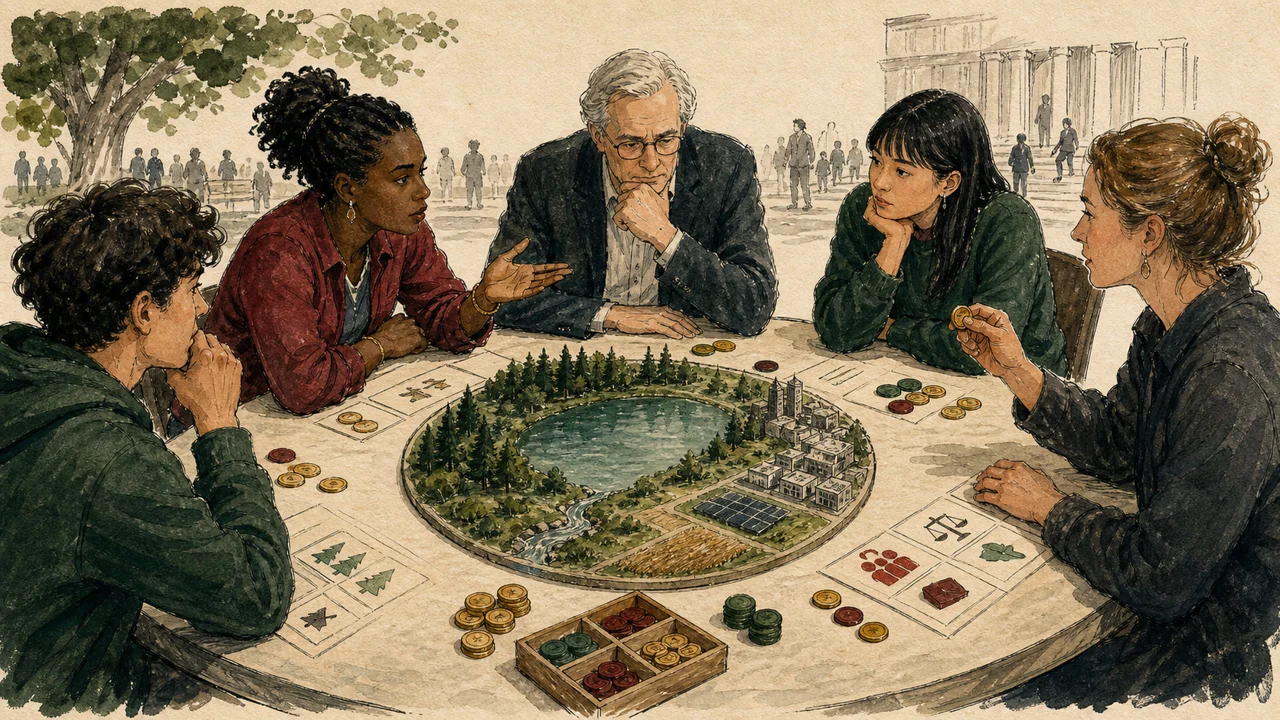
수능 영어에서 “공공재, 무임승차와 공유지 거버넌스” 주제는 용어 암기에서 끝나지 않고 낯선 지문의 논리를 빠르게 잡는 배경지식이 됩니다. 이 수업은 “공공재 협력은 평판이나 직접적 보답이 없을 때도 어떻게 퍼지며, 처벌은 왜 협력과 신뢰에 서로 다른 효과를 낼 수 있는가”이라는 질문에서 출발해 영어 원문, 구조 지도, 수능형 추론 문제를 한 흐름으로 연결합니다.
학습 안내
| 항목 | 내용 |
|---|---|
| 추천 대상 | 고3 · CEFR B2-C1 |
| 배경지식 영역 | 사회·경제 |
| 핵심 질문 | 공공재 협력은 평판이나 직접적 보답이 없을 때도 어떻게 퍼지며, 처벌은 왜 협력과 신뢰에 서로 다른 효과를 낼 수 있는가? |
| 학습 순서 | 개념 미리보기 → 영어 지문 듣기·읽기 → 구조 분석 → 수능형 문제 → 해설 |
| 예상 학습 시간 | 20 min |
Background Preview
공공재 게임에서 개인 기여금은 늘어나 모두에게 돌아오지만, 기여하지 않고 몫만 받으려는 무임승차자(free rider)가 생길 수 있다. 지문은 신뢰와 기여가 직접 만난 사람을 넘어 네트워크를 따라 퍼질 수 있음을 보여 주면서, 제재가 협력을 높여도 신뢰 자체는 훼손할 수 있다는 역설을 제시한다.
중심 질문: 공공재 협력은 평판이나 직접적 보답이 없을 때도 어떻게 퍼지며, 처벌은 왜 협력과 신뢰에 서로 다른 효과를 낼 수 있는가?
Read And Listen
[Ⅰ] For a 2010 study, social network gurus James Fowler and Nicholas Christakis had people play a series of “public goods” games with different groups of strangers. In these games, subjects staked with a modest amount of money can give whatever they want to a communal pot of money that is then tripled in value and split evenly. After each round, everybody learns who gave what. Usually in these games, people start off trusting each other to some degree. Then some players inevitably try to get something for nothing, or next to nothing, and their free riding eventually kills trust and drives donations into the ground. [Ⅱ] In Fowler and Christakis’s study, however, subjects dealt with a new group of players every time. Each round was a fresh start and a one–shot deal, so neither reputation nor reciprocity had any pull. Nevertheless, the players’ contributions in any given round rose and fell according to how generous their fellow players had been in earlier rounds. The more those previous partners had given — indeed, the more that previous partners of those previous partners had given — the more trusting and generous subjects would be with their new group. Even without concern over developing a reputation, or an opportunity to reciprocate, trust ripples out. [Ⅲ] Trust can evaporate just as easily. Ironically, punishments for not cooperating can backfire precisely because they imply low expectations for trustworthy behavior. If people could be trusted, after all, then no sanctions would be necessary. In one recent experiment, people played two rounds of a trust game. Some initially played with punishments for violating trust and then played a second round without these sanctions. Everyone rated how much they trusted their fellow group members on a sliding scale. People who played under the threat of sanctions cooperated more, but trusted each other less than those who played without sanctions. When the sanctions were removed, the value of trust dropped even further and cooperation among these players took a nosedive.
Shadowing Focus
- For a 2010 study, social network gurus James Fowler and Nicholas Christakis had people play a series of “public goods” games with different groups of strangers.
- Then some players inevitably try to get something for nothing, or next to nothing, and their free riding eventually kills trust and drives donations into the ground.
- Each round was a fresh start and a one–shot deal, so neither reputation nor reciprocity had any pull.
- The more those previous partners had given — indeed, the more that previous partners of those previous partners had given — the more trusting and generous subjects would be with their new group.
- Ironically, punishments for not cooperating can backfire precisely because they imply low expectations for trustworthy behavior.
Structure Map
핵심 구조
| 요소 | 내용 |
|---|---|
| Topic | 공공재 게임에서 신뢰, 무임승차, 제재의 상호작용 |
| Thesis | 협력적 행동은 네트워크를 따라 확산되지만 낮은 신뢰를 전제한 제재는 장기 협력을 약화할 수 있다. |
| Evidence | 이전 파트너와 그 파트너의 기여가 새 집단에서의 기여를 높였고, 제재 집단은 더 협력하면서도 덜 신뢰했다. |
| Contrast | 기여 없이 이익을 얻는 무임승차와 공동 자금에 기여하는 협력이 대조된다. |
| Concession | 제재는 단기 협력을 높일 수 있다는 점에서 전적으로 무효하지 않다. |
| Conclusion | 공유 자원의 거버넌스는 행동 통제뿐 아니라 신뢰 신호의 효과도 고려해야 한다. |
문단별 수사 기능
- [Ⅰ] 게임과 문제 설정: 공공재 규칙과 무임승차가 신뢰를 무너뜨리는 일반 패턴을 제시한다.
- [Ⅱ] 확산의 증거: 직접 평판과 호혜성이 없어도 이전 협력이 새 집단의 기여에 영향을 줌을 보인다.
- [Ⅲ] 제재의 역설: 처벌이 협력을 높이면서 신뢰를 낮추는 상반된 결과를 설명한다.
B2-C1 어휘와 구문
- communal pot: 공동 자금
- free riding: 무임승차
- reciprocity: 호혜성
- have pull: 영향력을 갖다
- sanction: 제재
- take a nosedive: 급격히 하락하다
- Although A, B: A를 인정하면서도 B를 중심 주장으로 제시하는 양보 구조다.
- The more A, the more B: A의 변화에 따라 B가 함께 변하는 비례 관계를 나타낸다.
CSAT Challenge
1. 빈칸 추론
다음 글의 빈칸에 들어갈 말로 가장 적절한 것을 고르시오.
Even without concern over developing a reputation, or an opportunity to reciprocate, ( ).
- sanctions become unnecessary
- free riders always disappear
- trust ripples out
- contributions remain fixed
- strangers refuse every game
2. 문장 삽입
주어진 문장이 들어가기에 가장 적절한 곳을 고르시오.
Trust can evaporate just as easily.
Earlier cooperation increased generosity toward new groups. ( ① ) The pattern showed that trust could ripple beyond direct partners. ( ② ) The researchers then considered the opposite movement. ( ③ ) Punishment can imply low expectations of trustworthy behavior. ( ④ ) When sanctions vanished, cooperation fell sharply. ( ⑤ )
- ①
- ②
- ③
- ④
- ⑤
3. 함축 의미 추론
밑줄 친 “their free riding eventually kills trust and drives donations into the ground”가 의미하는 바로 가장 적절한 것을 고르시오.
- 무임승차는 공동 자금의 가치를 자동으로 높인다.
- 기여하지 않는 행동이 협력 기대를 훼손해 다른 사람의 기여도 급감시킨다.
- 제재가 모든 참가자의 신뢰를 즉시 회복한다.
- 기부액은 타인의 행동과 무관하게 유지된다.
- 무임승차자는 장기적으로 더 많은 평판을 얻는다.
Answer Lab
정답과 해설 보기
1. 빈칸 추론: 정답 ③
근거: 지문의 핵심 인과와 결론을 그대로 완성하는 선택지는 3번이다. 빈칸 앞뒤의 논리 표지와 협력적 행동은 네트워크를 따라 확산되지만 낮은 신뢰를 전제한 제재는 장기 협력을 약화할 수 있다.라는 중심 주장을 함께 보존한다.
오답 분석: ①·②는 지문에 없는 조건을 더하거나 논리 방향을 바꾼다. ④·⑤는 핵심 개념의 효과를 과장하거나 반대로 서술한다.
교사 설명: 빈칸은 개별 사례보다 필자가 일반화한 문장을 우선 확인한다. 선택지가 원문의 주체, 방향, 강도를 모두 유지하는지 검토해야 한다.
2. 문장 삽입: 정답 ②
근거: 주어진 문장은 앞 내용의 결과를 받아 다음 설명으로 전환한다. 2 위치에서만 앞 문장의 정보가 이미 마련되고 뒤 문장의 지시 대상과 논리 흐름이 자연스럽게 이어진다.
오답 분석: 앞쪽 위치들은 필요한 배경이나 대조 항이 아직 제시되지 않았다. 뒤쪽 위치들은 원인과 결과 또는 일반화와 사례 사이의 결속을 끊는다.
교사 설명: 접속 표현뿐 아니라 문단의 수사 단계인 설정 → 근거 → 해석을 확인하면 위치를 안정적으로 결정할 수 있다.
3. 함축 의미 추론: 정답 ②
근거: 표현의 직전·직후 설명을 바꾸어 말하면 2번과 같다. 이는 협력적 행동은 네트워크를 따라 확산되지만 낮은 신뢰를 전제한 제재는 장기 협력을 약화할 수 있다.
오답 분석: 나머지 선택지는 행위의 방향을 뒤집거나, 지문이 제한적으로 말한 현상을 언제나 성립하는 절대 명제로 바꾼다.
교사 설명: 함축 의미는 표현 자체의 사전적 뜻보다 문맥에서 맡은 기능을 묻는다. 같은 단락의 사례와 결론에 동시에 들어맞는 해석을 고른다.
Knowledge Links
관련 주제
- 공정성, 호혜성과 협력 게임 | Fairness, Reciprocity, and Cooperation Games: 협력 규범을 지키기 위한 비용 감수와 연결한다.
- 공유지의 비극과 기후 협력 | Tragedy of the Commons and Climate Cooperation: 공유 자원의 무임승차 문제를 환경 영역으로 확장한다.
- 약한 연결과 사회자본 | Weak Ties and Social Capital: 신뢰와 정보가 네트워크를 따라 퍼지는 방식을 비교한다.
이전 주제: 이타성과 도움 행동 | Altruism and Helping Behavior
다음 주제: 약한 연결과 사회자본 | Weak Ties and Social Capital
자주 묻는 질문
“공공재, 무임승차와 공유지 거버넌스” 주제는 수능 영어에서 어떻게 활용되나요?
“공공재 협력은 평판이나 직접적 보답이 없을 때도 어떻게 퍼지며, 처벌은 왜 협력과 신뢰에 서로 다른 효과를 낼 수 있는가”에 답할 때는 원인과 결과, 대조, 사례, 함축 의미 속에서 공공재, 무임승차와 공유지 거버넌스의 논리를 따라가야 합니다. 개념명보다 공공재, 무임승차와 공유지 거버넌스 글의 필자가 어떤 근거로 결론에 도달하는지 표시하세요.
Public Goods, Free Riders, and Commons Governance 지문은 어떤 순서로 공부하면 좋나요?
먼저 “공공재 협력은 평판이나 직접적 보답이 없을 때도 어떻게 퍼지며, 처벌은 왜 협력과 신뢰에 서로 다른 효과를 낼 수 있는가”이라는 중심 질문을 확인하고 영어 지문을 소리 내어 읽습니다. 그다음 공공재, 무임승차와 공유지 거버넌스 구조 지도를 가리고 Topic, Thesis, Evidence를 직접 적은 뒤 수능형 문제와 해설로 추론이 맞았는지 확인하세요.