
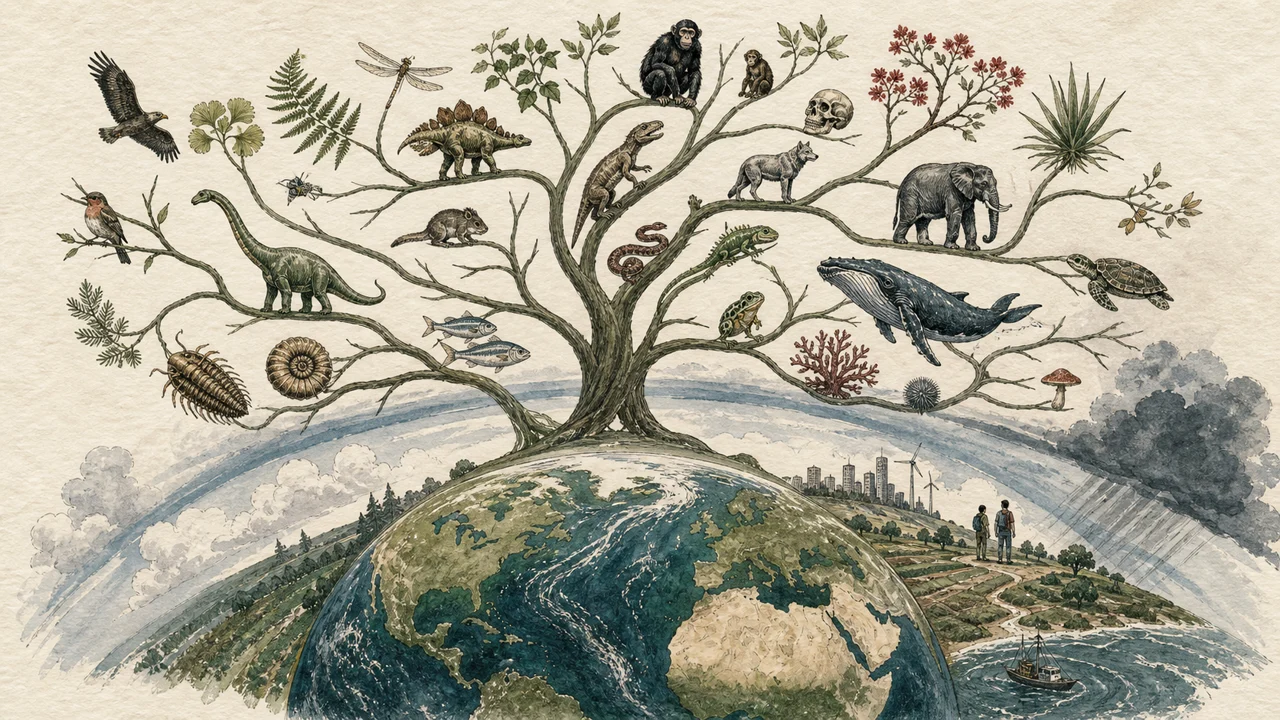
수능 영어에서 “공유지의 비극과 기후 협력” 주제는 용어 암기에서 끝나지 않고 낯선 지문의 논리를 빠르게 잡는 배경지식이 됩니다. 이 수업은 “개인의 자기 이익이 존재하는데도 공동 자원을 오래 지키게 하는 제도적 조건은 무엇인가”이라는 질문에서 출발해 영어 원문, 구조 지도, 수능형 추론 문제를 한 흐름으로 연결합니다.
학습 안내
| 항목 | 내용 |
|---|---|
| 추천 대상 | 고3 · CEFR B2-C1 |
| 배경지식 영역 | 환경·진화 |
| 핵심 질문 | 개인의 자기 이익이 존재하는데도 공동 자원을 오래 지키게 하는 제도적 조건은 무엇인가? |
| 학습 순서 | 개념 미리보기 → 영어 지문 듣기·읽기 → 구조 분석 → 수능형 문제 → 해설 |
| 예상 학습 시간 | 20 min |
Background Preview
공유지의 비극은 각자가 눈앞의 이익을 추구하면 공동 자원이 고갈된다는 경고다. 그러나 엘리너 오스트롬은 공유지가 반드시 파괴되는 것은 아니며, 구성원이 공정한 규칙을 함께 만들고 피드백을 지속하면 오랫동안 관리될 수 있음을 다양한 사례로 보였다. 국가 간 기후 협력도 강제와 시장만의 문제가 아니라 신뢰, 참여, 장기 보존 규범을 설계하는 문제다.
중심 질문: 개인의 자기 이익이 존재하는데도 공동 자원을 오래 지키게 하는 제도적 조건은 무엇인가?
출처: The Zero Marginal Cost Society: The Internet of Things, the Collaborative Commons, and the Eclipse of Capitalism — Jeremy Rifkin
Read And Listen
오스트롬 연구의 의의, 비교 사례, 하딘 명제에 대한 반박, 성공한 공유지의 핵심 자산 순서로 읽어 보자.
〈가〉 In her book The Governing of the Commons, Elinor Ostrom, an economist who served on the faculties of both Indiana University and Arizona State University, wrote the first comprehensive economic and anthropological analysis on the history of the commons, covering a thousand-year span. Her work dazzled the intellectual community and even the economic academy. Ostrom’s insightful analysis of why commons governance had succeeded and failed in the past, and her pragmatic prescriptions for ensuring the success of future Commons management, won her the coveted Nobel Prize in economics in 2009 ― making her the first woman ever to receive the honer. 〈나〉 Ostrom, although every bit the economist, was not shy about taking the role of an anthropologist. She studied commons management schemes from the Swiss Alps to Japanese villages to discover the underlying principles that made them effective governing models. At the very onset of her work, she took care to explain that many of the commons institutions she catalogued had, in her words, “survived droughts, floods, wars, pestilence, and major economic and political changes” over long sweeps of history, making it crystal clear that the commons has proven itself to be a formidable governing institution and worthy of reconsideration in light of the environmental, economic, and social challenges and opportunities facing humanity in an increasingly connected global world. 〈다〉 Her research contradicted Hardin’s assertion that “all commons were destined to ruin because of free riding and cast doubt on the long-held shibboleth among economists ― dating back to Adam Smith ― that each individual seeks only his or her own immediate self-interest in the market. What Ostrom found instead is that in managing common-pool resources ― pastures for grazing animals, fisheries, irrigation systems, forests, and the like ― individuals, more often than not, put the community’s interest before self-interest and the long-term preservation of the common resource above each person’s immediate circumstances, even when their plight was dire. 〈라〉 In each instance, the glue that kept the commons viable was the agreed-upon self-management protocols entered into voluntarily by the democratic participation of all the members. It was the continuous collaboration and feedback that created bonds of social trust, generation after generation. The social bonds kept the commons from ossifying and falling apart. In the worst of times, the “social capital” proved to be the central asset that allowed the commons to soldier on.
Shadowing Focus
- She studied commons management schemes from the Swiss Alps to Japanese villages to discover the underlying principles that made them effective governing models.
- Her work dazzled the intellectual community and even the economic academy.
- In each instance, the glue that kept the commons viable was the agreed-upon self-management protocols entered into voluntarily by the democratic participation of all the members.
- It was the continuous collaboration and feedback that created bonds of social trust, generation after generation.
- In the worst of times, the “social capital” proved to be the central asset that allowed the commons to soldier on.
Structure Map
논지 구조
- Topic: 장기간 지속된 공유지 자치의 조건
- Thesis: 공유지는 운명적으로 붕괴하지 않으며 민주적 자율 규칙, 협업, 피드백, 사회적 신뢰가 유지의 핵심이다.
- Evidence: 스위스 알프스와 일본 마을을 비롯한 천 년 범위의 제도 사례가 비교된다.
- Contrast: 하딘의 필연적 파괴 명제와 오스트롬의 조건부 성공 사례가 대립한다.
- Conclusion: 위기 속에서도 공동 자원을 지키는 중심 자산은 사회적 자본이다.
문단별 기능
- 〈가〉 연구 소개: 공유지 거버넌스 연구의 범위와 학문적 성과를 제시한다.
- 〈나〉 사례 일반화: 오래 생존한 제도에서 효과적인 원리를 찾는다.
- 〈다〉 기존 명제 반박: 인간이 언제나 즉각적 자기 이익만 좇는다는 가정을 뒤집는다.
- 〈라〉 성공 조건 제시: 자발적 규칙과 사회적 신뢰를 공유지의 결속 장치로 설명한다.
B2-C1 어휘와 구문
- commons governance: 공동 자원을 구성원이 관리하는 거버넌스
- pragmatic prescription: 실제 적용을 중시하는 실용적 처방
- common-pool resources: 배제는 어렵고 사용 경쟁은 존재하는 공동 자원
- free riding: 비용을 부담하지 않고 공동 이익만 얻는 무임승차
- self-management protocol: 구성원이 합의해 스스로 집행하는 관리 규칙
- social capital: 신뢰와 협력을 가능하게 하는 관계 자산
although every bit the economist: 경제학자임을 인정하면서 인류학적 접근을 강조하는 양보 구조다.more often than not: 예외를 허용하되 일반적 경향이 더 자주 나타남을 뜻한다.
CSAT Challenge
1. 빈칸 추론
다음 빈칸에 들어갈 말로 가장 적절한 것을 고르시오.
Ostrom’s cases imply that the tragedy of the commons is not inevitable when users build ________.
- secret ownership claims
- short-term extraction races
- voluntary rules and social trust
- complete isolation from feedback
- dependence on individual profit alone
2. 글의 순서
주어진 글 다음에 이어질 글의 순서로 가장 적절한 것을 고르시오.
Ostrom compared commons institutions across regions and long periods.
(A) She then identified voluntary protocols, collaboration, and feedback as the forces that sustained them. (B) These findings contradicted the claim that free riding condemns every commons to ruin. (C) Her cases first showed that some institutions survived severe environmental and political shocks.
- (A) - (B) - (C)
- (A) - (C) - (B)
- (B) - (A) - (C)
- (C) - (A) - (B)
- (C) - (B) - (A)
3. 함축 의미
다음 표현이 함축하는 바로 가장 적절한 것을 고르시오.
the glue that kept the commons viable
- 공유지를 물리적으로 분할한 울타리
- 참여자가 함께 받아들인 규칙과 신뢰의 결속력
- 자원을 빠르게 사유화하는 시장 가격
- 외부 권위가 일방적으로 부과한 처벌
- 공동체가 변화를 거부하는 경직성
Answer Lab
정답 및 해설 보기
1. 빈칸 추론
정답: 3번
- 근거: 마지막 문단은 자발적 자기관리 규칙, 협업, 피드백, 사회적 신뢰를 지속 가능성의 조건으로 묶는다.
- 오답 분석: 1번과 4번은 민주적 참여와 피드백에 반한다. 2번은 공유지의 비극을 촉진하고, 5번은 공동체 이익을 앞세운 관찰 결과와 반대다.
- 교사 해설:
not inevitable when뒤에는 하딘의 예측을 뒤집는 조건이 와야 한다.
2. 글의 순서
정답: 5번(C-B-A)
- 근거: 생존 사례(C)가 먼저 제시되고,
These findings가 이를 받아 기존 명제를 반박(B)한 뒤,then이 성공 조건(A)을 도출한다. - 오답 분석: A를 먼저 두면 지속 대상이 제시되기 전에 원인이 나온다. B를 먼저 두면
These findings의 선행 내용이 없다. C-A-B는 본문의 반박 후 조건 제시 순서를 바꾼다. - 교사 해설: 지시어
These findings와 시간·논리 표지then이 배열을 고정한다.
3. 함축 의미
정답: 2번
- 근거:
glue는 바로 뒤의 합의된 자기관리 규칙과 이어지는 사회적 신뢰를 비유한다. - 오답 분석: 1번과 3번은 물리적 분할·사유화를 뜻하지 않는다. 4번은 자발적 참여와 반대이고, 5번은 제도가 경직되지 않게 했다는 설명을 뒤집는다.
- 교사 해설: 비유 표현의 구체적 내용은 같은 문장의 보어와 다음 두 문장에서 찾아야 한다.
Knowledge Links
관련 주제
- 배출권 거래제와 생태발자국 (
environment-evolution-02) - 공동 자원 보호를 시장 제도와 개인 가치의 관점에서 비교한다. - 공공재, 무임승차와 공유지 거버넌스 (
society-economics-05) - 무임승차와 공동 자원 관리의 경제학을 확장한다. - 가이아 이론, 인류세와 행성 경계 (
environment-evolution-01) - 국제 협력이 지켜야 할 행성 차원의 임계점을 연결한다.
시리즈 이동
- 이전: 배출권 거래제와 생태발자국 (
environment-evolution-02) - 다음: 자연선택, 사회진화론과 상호부조 (
environment-evolution-04)
자주 묻는 질문
“공유지의 비극과 기후 협력” 주제는 수능 영어에서 어떻게 활용되나요?
“개인의 자기 이익이 존재하는데도 공동 자원을 오래 지키게 하는 제도적 조건은 무엇인가”에 답할 때는 원인과 결과, 대조, 사례, 함축 의미 속에서 공유지의 비극과 기후 협력의 논리를 따라가야 합니다. 개념명보다 공유지의 비극과 기후 협력 글의 필자가 어떤 근거로 결론에 도달하는지 표시하세요.
Tragedy of the Commons and Climate Cooperation 지문은 어떤 순서로 공부하면 좋나요?
먼저 “개인의 자기 이익이 존재하는데도 공동 자원을 오래 지키게 하는 제도적 조건은 무엇인가”이라는 중심 질문을 확인하고 영어 지문을 소리 내어 읽습니다. 그다음 공유지의 비극과 기후 협력 구조 지도를 가리고 Topic, Thesis, Evidence를 직접 적은 뒤 수능형 문제와 해설로 추론이 맞았는지 확인하세요.