
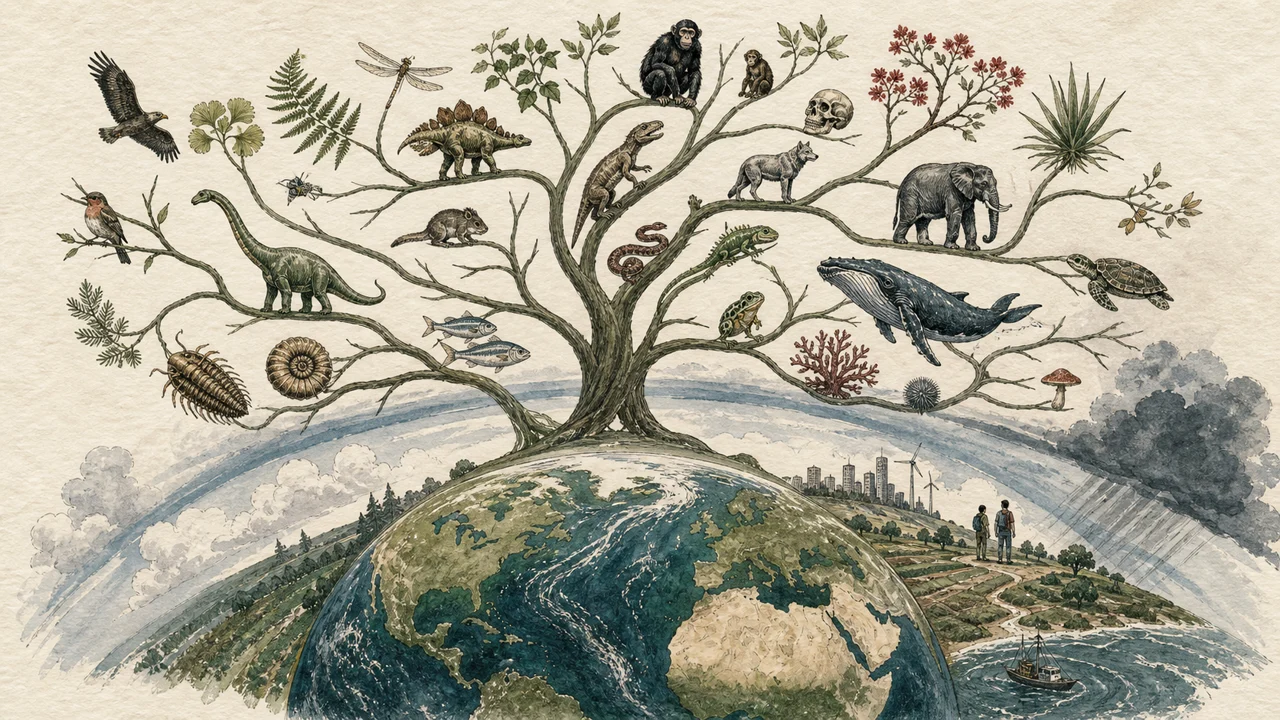
수능 영어에서 “가이아 이론, 인류세와 행성 경계” 주제는 용어 암기에서 끝나지 않고 낯선 지문의 논리를 빠르게 잡는 배경지식이 됩니다. 이 수업은 “자기 조절하는 지구라는 관점은 왜 인간이 만든 비가역적 변화의 가능성 앞에서 수정되어야 하는가”이라는 질문에서 출발해 영어 원문, 구조 지도, 수능형 추론 문제를 한 흐름으로 연결합니다.
학습 안내
| 항목 | 내용 |
|---|---|
| 추천 대상 | 고3 · CEFR B2-C1 |
| 배경지식 영역 | 환경·진화 |
| 핵심 질문 | 자기 조절하는 지구라는 관점은 왜 인간이 만든 비가역적 변화의 가능성 앞에서 수정되어야 하는가? |
| 학습 순서 | 개념 미리보기 → 영어 지문 듣기·읽기 → 구조 분석 → 수능형 문제 → 해설 |
| 예상 학습 시간 | 20 min |
Background Preview
가이아 가설은 지구를 생물과 비생물이 상호작용하며 균형을 유지하는 자기 조절 체계로 본다. 그러나 오존층 파괴와 인위적 기후 변화는 인간의 활동이 이 체계에 비해 미미하다는 초기 가정을 흔들었다. 인류세는 인간 사회가 지질학적 힘이 되었다는 관점을, 행성 경계는 그 힘이 넘어서는 안 될 임계 범위를 설명한다.
중심 질문: 자기 조절하는 지구라는 관점은 왜 인간이 만든 비가역적 변화의 가능성 앞에서 수정되어야 하는가?
출처: Media and the Politics of Arctic Climate Change: When the Ice Breaks — Miyase Christensen, Annika E. Nilsson, Nina Wormbs
Read And Listen
가이아 가설의 초기 전제에서 출발해 인간의 지질학적 영향력과 북극의 임계점 사례로 논지가 이동하는 흐름을 따라 읽어 보자.
[Ⅰ] In the 1970s, the physicist James Lovelock wrote about the planet Earth in relation to what he termed the Gaia hypothesis. The main idea was that Earth is a self‒regulating system that will seek to maintain equilibrium, initially including an implicit assumption that human acti‒ vities were insignificant in relation to Earth’s homeostatic mechanisms. It was criticized already during its time, but suffered a more severe blow due to the observations of the Earth’s atmosphere, which yielded the discovery of the ozone hole over Antarctica in 1985. Chemicals produced by humankind did indeed change the atmosphere in ways that affect life on Earth in fundamental ways. [Ⅱ] The evidence of anthropogenic climate change also shows that the magnitude of power human society has over nature is large enough to be conceived as a geological force. More recently the discourse on global change has incorporated not only the notion of major gradual change, but also attention to thresholds or tipping points. These are abrupt changes in biophysical or social systems that can be the result of many interacting drivers of change. The term tipping point is often, but not always, used to describe a change that is difficult to reverse. It is a regime shift into a new stable state. [Ⅲ] Tipping points have been studied for some time in local ecosystems, such as lakes turning from clear to turbid. In the Arctic, there is increasing interest in understanding the risk for thresholds in both ecosystems and in linked social‒ecological systems. One could argue that the loss of Arctic sea ice in the summer, in and of itself and in terms of its consequences, is an example of the Arctic having passed an irreversible threshold. How‒ ever, given the complexity of the systems involved, we may not fully grasp for many years the significance of what is happening now.
Shadowing Focus
- Chemicals produced by humankind did indeed change the atmosphere in ways that affect life on Earth in fundamental ways.
- The evidence of anthropogenic climate change also shows that the magnitude of power human society has over nature is large enough to be conceived as a geological force.
- These are abrupt changes in biophysical or social systems that can be the result of many interacting drivers of change.
- The term tipping point is often, but not always, used to describe a change that is difficult to reverse.
- It is a regime shift into a new stable state.
Structure Map
논지 구조
- Topic: 가이아 가설에서 인류세와 임계점 논의로 이동한 지구 시스템 인식
- Thesis: 인간 사회의 영향력은 지구의 자기 조절 능력에 비해 무시할 수 있는 수준이 아니라, 체제를 바꿀 수 있는 지질학적 힘이다.
- Evidence: 1985년 남극 오존 구멍의 발견은 인간이 만든 화학물질이 생명에 근본적인 영향을 주는 방식으로 대기를 변화시켰음을 보여 준다.
- Contrast: 초기 가이아 가설은 인간 활동의 영향력을 미미하게 보았지만, 인위적 기후 변화의 증거는 그 영향력이 거대함을 드러낸다.
- Concession: 모든 tipping point가 반드시 비가역적인 것은 아니며, 복잡한 체계의 현재 변화가 지닌 의미도 곧바로 확정하기 어렵다.
- Conclusion: 북극 해빙 감소는 이미 비가역적 임계점을 넘은 사례일 수 있으므로, 장기적 결과가 완전히 밝혀지기 전에도 체제 전환의 위험을 고려해야 한다.
문단별 기능
- [Ⅰ] 기존 이론과 반례: 가이아 가설의 자기 조절 전제를 소개한 뒤 오존 구멍을 반증 사례로 제시한다.
- [Ⅱ] 개념 확장과 정의: 인간을 지질학적 힘으로 규정하고 tipping point를 새로운 안정 상태로의 체제 전환으로 정의한다.
- [Ⅲ] 구체화와 인식의 한계: 호수와 북극 해빙 사례를 제시하면서 복잡한 시스템의 의미를 판단하는 데 시간이 필요함을 덧붙인다.
B2-C1 어휘와 구문
- self-regulating: 외부 지시 없이 내부 상호작용으로 상태를 조절하는
- homeostatic mechanisms: 체계의 상대적 안정성을 유지하는 항상성 기제
- anthropogenic: 인간 활동에 의해 발생한
- geological force: 지층과 지구 시스템의 상태를 바꿀 만큼 큰 힘
- threshold / tipping point: 체계가 다른 상태로 급격히 전환되는 임계점
- regime shift: 기존 균형에서 새로운 안정 상태로 넘어가는 체제 전환
not only A, but also B: 점진적 변화뿐 아니라 임계점에도 관심이 확대되었음을 강조한다.given + 명사구: “given the complexity …”는 복잡성을 판단의 조건 또는 이유로 제시한다.may not fully grasp for many years: 조동사와 기간 표현을 결합해 장기적 인식의 불확실성을 나타낸다.
CSAT Challenge
1. 빈칸 추론
다음 빈칸에 들어갈 말로 가장 적절한 것을 고르시오.
The term tipping point is often, but not always, used to describe a change that is difficult to reverse. It is ________.
- a temporary fluctuation within the former equilibrium
- a regime shift into a new stable state
- a gradual recovery led by a single natural driver
- an insignificant change absorbed by homeostatic mechanisms
- a prediction limited to the chemistry of the atmosphere
2. 문장 삽입
주어진 문장이 들어가기에 가장 적절한 곳을 고르시오.
It is a regime shift into a new stable state.
The evidence of anthropogenic climate change also shows that the magnitude of power human society has over nature is large enough to be conceived as a geological force. ( ① ) More recently the discourse on global change has incorporated not only the notion of major gradual change, but also attention to thresholds or tipping points. ( ② ) These are abrupt changes in biophysical or social systems that can be the result of many interacting drivers of change. ( ③ ) The term tipping point is often, but not always, used to describe a change that is difficult to reverse. ( ④ ) Tipping points have been studied for some time in local ecosystems, such as lakes turning from clear to turbid. ( ⑤ )
- ①
- ②
- ③
- ④
- ⑤
3. 함축 의미
다음 문장이 함축하는 바로 가장 적절한 것을 고르시오.
we may not fully grasp for many years the significance of what is happening now
- 현재의 북극 변화는 관측할 가치가 없으므로 연구를 중단해야 한다.
- 복잡한 시스템에서는 현재 변화의 장기적 의미가 나중에야 분명해질 수 있다.
- 북극 해빙 감소는 이미 아무 결과 없이 완전히 되돌려졌다.
- 임계점은 단일 원인만 확인하면 즉시 정확하게 예측할 수 있다.
- 인간 활동은 지구의 항상성 기제에 비해 언제나 미미하다.
Answer Lab
정답 및 해설 보기
1. 빈칸 추론
정답: 2번
- 근거: 바로 앞 문장이 tipping point를 되돌리기 어려운 변화라고 설명하고, 원문은 이어서 이를 새로운 안정 상태로의
regime shift라고 정의한다. - 오답 분석: 1번과 3번은 비가역성과 급격한 전환을 각각 일시적·점진적 변화로 바꾼다. 4번은 임계점을 기존 항상성이 흡수하는 변화로 축소한다. 5번은 논의를 대기 화학 하나로 제한하지만 본문은 생물물리적·사회적 시스템 전체를 다룬다.
- 교사 해설: 빈칸 앞의
difficult to reverse와 뒤 문단의 생태계 사례를 연결하면, 기존 균형 내부의 변동이 아니라 새로운 균형으로 넘어가는 전환이 필요하다.
2. 문장 삽입
정답: 4번(④)
- 근거: 주어진 문장의
It은 직전 문장의a change that is difficult to reverse를 받아 그 변화를a regime shift로 다시 정의한다. 다음 문단은 이 정의를 전제로 실제 생태계 사례를 제시한다. - 오답 분석: ①은 tipping point가 아직 제시되지 않아
It의 지시 대상이 없다. ②와 ③은 정의의 핵심 문장 사이를 끊는다. ⑤는 호수 사례 뒤에 정의가 뒤늦게 놓여 개념 제시 후 사례라는 전개가 무너진다. - 교사 해설: 지시어의 선행사와 ‘개념 제시 → 정의 → 사례’의 정보 배열을 함께 확인하는 문제다.
3. 함축 의미
정답: 2번
- 근거: 저자는 북극 해빙이 비가역적 임계점을 넘었을 가능성을 제시하면서도, 관련 시스템의 복잡성 때문에 현재 사건의 의미를 완전히 파악하는 데 오랜 시간이 걸릴 수 있다고 말한다.
- 오답 분석: 1번은 불확실성을 연구 포기의 근거로 왜곡한다. 3번은
irreversible threshold와 반대다. 4번은 여러 변화 요인이 상호작용한다는 설명을 무시한다. 5번은 오존 구멍과 인위적 기후 변화가 반박한 초기 가정을 되풀이한다. - 교사 해설:
may not은 무의미함이 아니라 인식의 유보를,for many years는 복잡한 인과와 장기 관찰의 필요성을 나타낸다.
Knowledge Links
관련 주제
- 세포내 공생과 공생 진화 (
science-technology-07) - 생물 간 상호작용이 더 큰 체계의 안정과 진화에 미치는 영향을 연결한다. - 공유지의 비극과 기후 협력 (
environment-evolution-03) - 행성 경계를 넘지 않기 위한 집단행동 문제를 살펴본다. - 생물다양성 핵심지역과 대멸종 (
environment-evolution-05) - 임계점과 회복력 저하를 생물다양성의 관점에서 확장한다.
시리즈 이동
- 이전: 동물해방, 감각능력과 도덕적 고려 (
philosophy-logic-10) - 다음: 배출권 거래제와 생태발자국 (
environment-evolution-02)
자주 묻는 질문
“가이아 이론, 인류세와 행성 경계” 주제는 수능 영어에서 어떻게 활용되나요?
“자기 조절하는 지구라는 관점은 왜 인간이 만든 비가역적 변화의 가능성 앞에서 수정되어야 하는가”에 답할 때는 원인과 결과, 대조, 사례, 함축 의미 속에서 가이아 이론, 인류세와 행성 경계의 논리를 따라가야 합니다. 개념명보다 가이아 이론, 인류세와 행성 경계 글의 필자가 어떤 근거로 결론에 도달하는지 표시하세요.
Gaia Theory, Anthropocene, and Planetary Boundaries 지문은 어떤 순서로 공부하면 좋나요?
먼저 “자기 조절하는 지구라는 관점은 왜 인간이 만든 비가역적 변화의 가능성 앞에서 수정되어야 하는가”이라는 중심 질문을 확인하고 영어 지문을 소리 내어 읽습니다. 그다음 가이아 이론, 인류세와 행성 경계 구조 지도를 가리고 Topic, Thesis, Evidence를 직접 적은 뒤 수능형 문제와 해설로 추론이 맞았는지 확인하세요.