
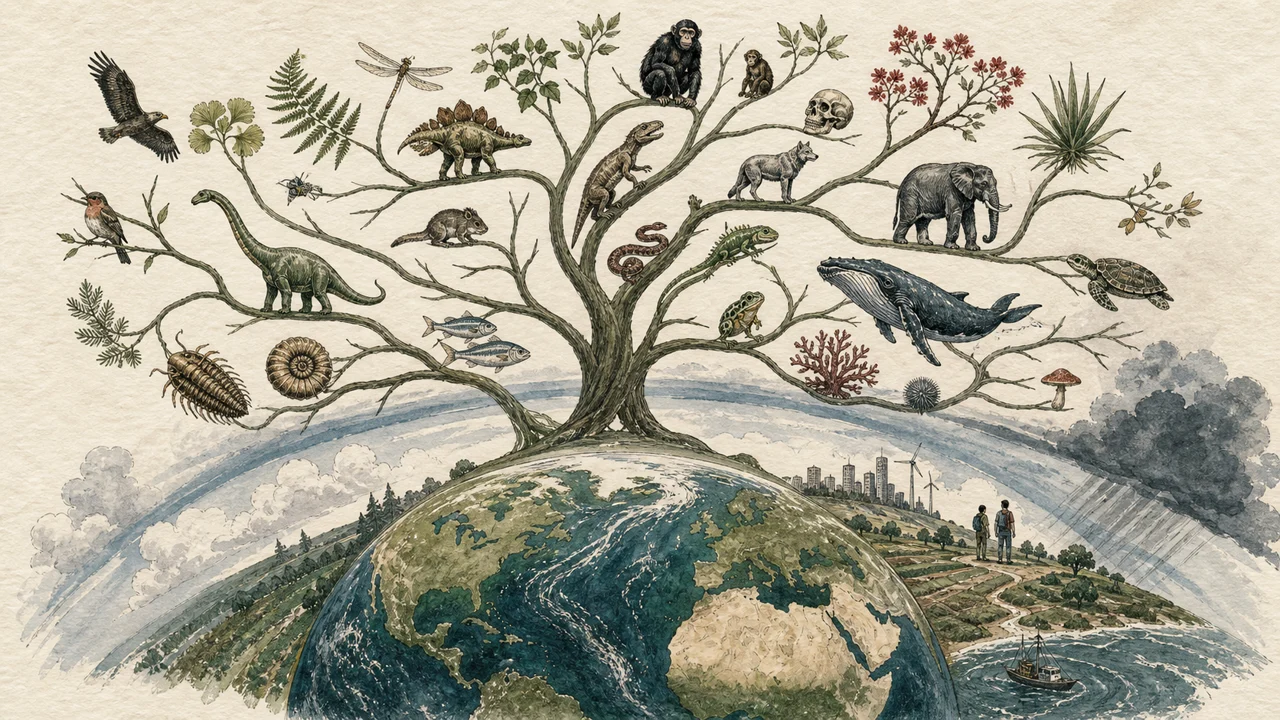
수능 영어에서 “생물다양성 핵심지역과 대멸종” 주제는 용어 암기에서 끝나지 않고 낯선 지문의 논리를 빠르게 잡는 배경지식이 됩니다. 이 수업은 “면적이 작은 핵심지역을 우선 보호하는 전략은 어떻게 전 지구적 멸종 위험을 줄이는가”이라는 질문에서 출발해 영어 원문, 구조 지도, 수능형 추론 문제를 한 흐름으로 연결합니다.
학습 안내
| 항목 | 내용 |
|---|---|
| 추천 대상 | 고3 · CEFR B2-C1 |
| 배경지식 영역 | 환경·진화 |
| 핵심 질문 | 면적이 작은 핵심지역을 우선 보호하는 전략은 어떻게 전 지구적 멸종 위험을 줄이는가? |
| 학습 순서 | 개념 미리보기 → 영어 지문 듣기·읽기 → 구조 분석 → 수능형 문제 → 해설 |
| 예상 학습 시간 | 20 min |
Background Preview
생물다양성은 유전자, 종, 생태계 수준의 생명 변이를 모두 포함한다. 그러나 보전 자원은 한정되어 있어 모든 지역을 같은 강도로 보호하기 어렵다. 생물다양성 핵심지역은 고유종이 많이 집중되어 있으면서 서식지 손실이 심각한 곳을 우선 보호 대상으로 정하는 개념이다. 현재의 빠른 멸종 위기 속에서 이 기준은 제한된 자원을 어디에 집중할지 결정하는 도구가 된다.
중심 질문: 면적이 작은 핵심지역을 우선 보호하는 전략은 어떻게 전 지구적 멸종 위험을 줄이는가?
출처: Village Development in North-East India: New Approaches — Komol Singha
Read And Listen
개념 정의에서 시작해 핵심지역의 필요성, 역사적 발전, 정량 기준으로 좁혀지는 설명 구조를 따라가자.
[Ⅰ] “Biodiversity” is often defined as the variety of all forms of life, from genes to species, through to the broad scale of ecosystems. “Biodiversity” was coined as a contraction of “biological diversity” in 1985, but the new term arguably has taken on a meaning and imports all of its own. A symposium in 1986 and the follow‒up book Biodiversity, edited by biologist E.O. Wilson, heralded the population of this concept. Ten years later, Takacs described its ascent. Overall, the major issue for biodiversity is how its conservation may be integrated with other needs of society. [Ⅱ] British ecologist Norman Myers defined the biodiversity hotspot concept in 1988 to address the dilemma that conservationists face: what areas are the most immediately important for conserving biodiversity? The biodiversity hotspots hold especially high numbers of endemic species, yet their combined area of remaining habitat covers only 2.3 per cent of the Earth’s land surface. Each hotspot faces extreme threats and has already lost at least 70 per cent of its original natural vegetation. Over 50 per cent of the world’s plant species and 42 per cent of all terrestrial vertebrate species are endemic to the 34 biodiversity hotspots. [Ⅲ] A seminal paper by Norman Myers in 1985 first identified ten tropical forest “hotspots” characterized both by exceptional levels of plant endemism and by serious levels of habitat loss. In 1990, Myers added a further eight hotspots, including four Mediterranean‒type ecosystems. Conservat‒ ional International adopted Myers’ hotspots as its institutional blueprint in 1989, and in 1996, the organization made the decision to undertake a reassessment of the hotspots concept, including an examination of whether key areas had been overlooked. [Ⅳ] Three years later an extensive global review was undertaken, which introduced quantitative thresholds for the designation of biodiversity hotspots: To qualify as a hotspot, a region must meet two strict criteria: it must contain at least 0.5% or 1,500 species of vascular plants as endemics, and it has to have lost at least 70% of its primary vegetation. Around the world, at least 25 areas qualify under this definition, with nine others possible candidates. These sites support nearly 60% of the world’s plant, bird, mammals, reptile and amphibian species, with a very high share of endemic species.
Shadowing Focus
- “Biodiversity” is often defined as the variety of all forms of life, from genes to species, through to the broad scale of ecosystems.
- Overall, the major issue for biodiversity is how its conservation may be integrated with other needs of society.
- The biodiversity hotspots hold especially high numbers of endemic species, yet their combined area of remaining habitat covers only 2.3 per cent of the Earth’s land surface.
- Each hotspot faces extreme threats and has already lost at least 70 per cent of its original natural vegetation.
- Around the world, at least 25 areas qualify under this definition, with nine others possible candidates.
Structure Map
논지 구조
- Topic: 생물다양성 핵심지역의 개념과 지정 기준
- Thesis: 고유종 집중도와 서식지 손실을 함께 측정하면 보전 우선순위를 정할 수 있다.
- Evidence: 극히 작은 잔존 면적에 세계 식물과 육상 척추동물 고유종이 집중되어 있다.
- Development: 마이어스의 초기 목록이 재평가와 정량 기준을 거쳐 확장되었다.
- Conclusion: 핵심지역 전략은 작은 면적의 보호로 많은 종의 멸종 위험을 낮추려는 선택과 집중이다.
문단별 기능
- [Ⅰ]-[Ⅱ] 정의와 필요성: 생물다양성을 정의하고 보전 우선지역의 딜레마를 제시한다.
- [Ⅲ] 개념의 발전: 초기 핵심지역 목록과 기관 차원의 재평가를 설명한다.
- [Ⅳ] 기준 확정: 고유 식물종 수와 식생 손실률이라는 두 문턱을 제시한다.
B2-C1 어휘와 구문
- biodiversity: 유전자부터 생태계까지 포괄하는 생물학적 다양성
- endemic species: 특정 지역에만 자연적으로 분포하는 고유종
- habitat loss: 생물이 살아갈 서식 환경의 감소·파괴
- quantitative threshold: 수치로 판정할 수 있는 정량적 문턱
- vascular plants: 물과 양분을 운반하는 관다발 조직을 가진 식물
- designation: 공식 기준에 따른 지정
characterized both by A and by B: 고유성과 서식지 손실이라는 두 특징을 병렬로 묶는다.To qualify as ...: 자격을 얻기 위해 충족해야 할 조건을 도입한다.
CSAT Challenge
1. 빈칸 추론
다음 빈칸에 들어갈 말로 가장 적절한 것을 고르시오.
A biodiversity hotspot is selected not merely for species richness but for the combination of endemism and ________.
- low conservation urgency
- severe habitat loss
- unlimited land area
- uniform global distribution
- absence of human needs
2. 글의 순서
주어진 글 다음에 이어질 글의 순서로 가장 적절한 것을 고르시오.
Conservationists needed a way to decide which regions required the most immediate attention.
(A) Later reviews converted the idea into thresholds for endemic plants and vegetation loss. (B) Myers first identified tropical forest hotspots with exceptional endemism and serious habitat loss. (C) The resulting criteria allowed regions around the world to be evaluated consistently.
- (A) - (B) - (C)
- (A) - (C) - (B)
- (B) - (A) - (C)
- (B) - (C) - (A)
- (C) - (B) - (A)
3. 함축 의미
다음 수치가 함축하는 바로 가장 적절한 것을 고르시오.
only 2.3 per cent of the Earth’s land surface
- 고유종이 전 세계에 균등하게 분포한다.
- 매우 제한된 면적에 보전 가치가 집중되어 있다.
- 핵심지역은 이미 위협을 완전히 벗어났다.
- 육상 척추동물은 핵심지역에 존재하지 않는다.
- 면적만 넓으면 자동으로 핵심지역이 된다.
Answer Lab
정답 및 해설 보기
1. 빈칸 추론
정답: 2번
- 근거: 지정 기준은 많은 고유 식물종과 70% 이상의 원식생 손실을 동시에 요구한다.
- 오답 분석: 1번은 긴급성과 반대다. 3번과 4번은 집중된 분포를 부정한다. 5번은 사회적 필요와 보전을 통합해야 한다는 문제의식을 지운다.
- 교사 해설:
not merely A but ...구조는 종 수 외에 위험 수준을 나타내는 조건을 요구한다.
2. 글의 순서
정답: 3번(B-A-C)
- 근거: 초기 식별(B),
Later reviews의 기준화(A),resulting criteria의 적용(C) 순서다. - 오답 분석: A나 C를 먼저 두면
Later와resulting의 선행 내용이 없다. B-C-A는 기준을 만들기 전에 적용 결과가 나온다. - 교사 해설: 시간 표지와 결과 지시어가 연대기적 전개를 고정한다.
3. 함축 의미
정답: 2번
- 근거: 작은 잔존 면적에 세계 고유 식물과 척추동물의 큰 비중이 모여 있다.
- 오답 분석: 1번은 집중성과 반대다. 3번은 70% 이상 손실과 모순된다. 4번은 척추동물 통계를 무시하고, 5번은 고유종과 손실 기준을 지운다.
- 교사 해설: 면적 수치는 뒤의 종 비율과 대비되어 보전 효율과 긴급성을 동시에 강조한다.
Knowledge Links
관련 주제
- 가이아 이론, 인류세와 행성 경계 (
environment-evolution-01) - 생태계 변화가 임계점을 넘는 위험을 연결한다. - 자연선택, 사회진화론과 상호부조 (
environment-evolution-04) - 종의 적응과 생존을 진화적 관점에서 살펴본다. - 혈연선택과 상호적 이타주의 (
environment-evolution-07) - 종 내부 행동이 생존에 기여하는 방식을 연결한다.
시리즈 이동
- 이전: 자연선택, 사회진화론과 상호부조 (
environment-evolution-04) - 다음: 붉은 여왕 효과와 적응 압력 (
environment-evolution-06)
자주 묻는 질문
“생물다양성 핵심지역과 대멸종” 주제는 수능 영어에서 어떻게 활용되나요?
“면적이 작은 핵심지역을 우선 보호하는 전략은 어떻게 전 지구적 멸종 위험을 줄이는가”에 답할 때는 원인과 결과, 대조, 사례, 함축 의미 속에서 생물다양성 핵심지역과 대멸종의 논리를 따라가야 합니다. 개념명보다 생물다양성 핵심지역과 대멸종 글의 필자가 어떤 근거로 결론에 도달하는지 표시하세요.
Biodiversity Hotspots and Mass Extinction 지문은 어떤 순서로 공부하면 좋나요?
먼저 “면적이 작은 핵심지역을 우선 보호하는 전략은 어떻게 전 지구적 멸종 위험을 줄이는가”이라는 중심 질문을 확인하고 영어 지문을 소리 내어 읽습니다. 그다음 생물다양성 핵심지역과 대멸종 구조 지도를 가리고 Topic, Thesis, Evidence를 직접 적은 뒤 수능형 문제와 해설로 추론이 맞았는지 확인하세요.