
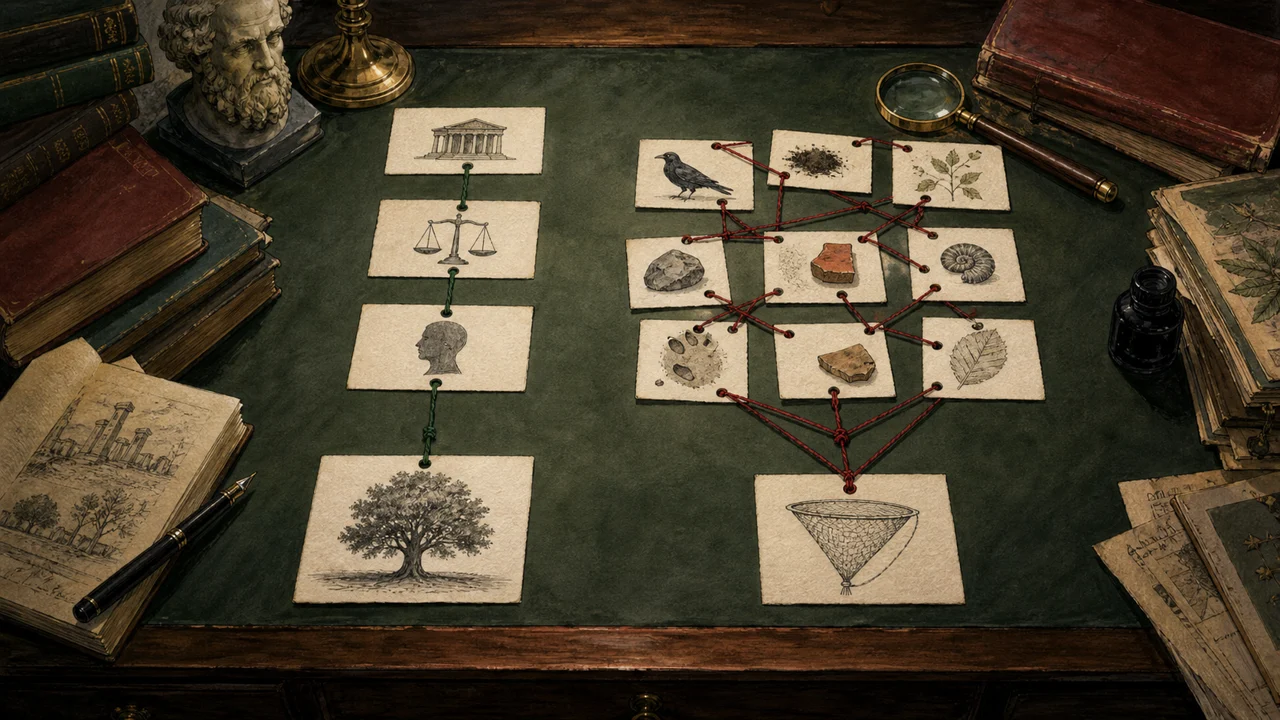
수능 영어에서 “연역과 귀납” 주제는 용어 암기에서 끝나지 않고 낯선 지문의 논리를 빠르게 잡는 배경지식이 됩니다. 이 수업은 “결론이 그럴듯해 보여도, 우리는 왜 그 결론이 나온 방향과 출발점을 함께 확인해야 할까”이라는 질문에서 출발해 영어 원문, 구조 지도, 수능형 추론 문제를 한 흐름으로 연결합니다.
학습 안내
| 항목 | 내용 |
|---|---|
| 추천 대상 | 고3 · CEFR B2-C1 |
| 배경지식 영역 | 철학·논리 |
| 핵심 질문 | 결론이 그럴듯해 보여도, 우리는 왜 그 결론이 나온 방향과 출발점을 함께 확인해야 할까? |
| 학습 순서 | 개념 미리보기 → 영어 지문 듣기·읽기 → 구조 분석 → 수능형 문제 → 해설 |
| 예상 학습 시간 | 20 min |
Background Preview
연역과 귀납은 결론에 도달하는 방향이 다릅니다. 연역(deduction)은 일반 이론이나 전제에서 구체적인 가설과 사례로 내려가고, 귀납(induction)은 개별 관찰에서 반복되는 패턴을 찾아 일반 원리로 올라갑니다. 그러나 추론의 방향만 안다고 충분한 것은 아닙니다. 연역은 출발 전제가 틀리면 결론의 현실적 신뢰성이 흔들리고, 귀납은 제한된 관찰을 지나치게 일반화할 위험이 있습니다.
중심 질문: 결론이 그럴듯해 보여도, 우리는 왜 그 결론이 나온 방향과 출발점을 함께 확인해야 할까?
Read And Listen
먼저 전체 글을 들으며 general → specific과 specific → general의 방향 전환을 표시해 보세요. 그다음 아래 다섯 문장을 한 문장씩 따라 읽습니다.
[Ⅰ] Deductive reasoning happens when a researcher works from the more general information to the more specific. Sometimes this is called the “top-down” approach because the researcher starts at the top with a very broad spectrum of information and they work their way down to a specific conclusion. For instance, a researcher might begin with a theory about his or her topic of interest. From there, he or she would narrow that down into more specific hypotheses that can be tested. The hypotheses are then narrowed down even further when observations are collected to test the hypotheses. This ultimately leads the researcher to be able to test the hypotheses with specific data, leading to a confirmation (or not) of the original theory and arriving at a conclusion. [Ⅱ] An example of deductive reasoning can be seen in this set of statements: Every day, I leave for work in my car at eight o’clock. Every day, the drive to work takes 45 minutes I arrive to work on time. Therefore, if I leave for work at eight o’clock today, I will be on time. The deductive statement above is a perfect logical statement, but it does rely on the initial premise being correct. Perhaps today there is construction on the way to work and you will end up being late. This is why any hypothesis can never be completely proved, because there is always the possibility for the initial premise to be wrong.
[Ⅲ] Inductive reasoning works the opposite way, moving from specific observations to broader generalizations and theories. This is sometimes called a “bottom up” approach. The researcher begins with specific observations and measures, begins to then detect patterns and regularities, formulate some tentative hypotheses to explore, and finally ends up developing some general conclusions or theories. An example of inductive reasoning can be seen in this set of statements: Today, I left for work at eight o’clock and I arrived on time. Therefore, every day that I leave the house at eight o’clock, I will arrive to work on time. [Ⅳ] While inductive reasoning is commonly used in science, it is not always logically valid because it is not always accurate to assume that a general principle is correct. In the example above, perhaps ‘today’ is a weekend with less traffic, so if you left the house at eight o’clock on a Monday, it would take longer and you would be late for work. It is illogical to assume an entire premise just because one specific data set seems to suggest it.
Shadowing Sentences
- Deductive reasoning happens when a researcher works from the more general information to the more specific.
- Sometimes this is called the “top-down” approach because the researcher starts at the top with a very broad spectrum of information and they work their way down to a specific conclusion.
- The deductive statement above is a perfect logical statement, but it does rely on the initial premise being correct.
- Inductive reasoning works the opposite way, moving from specific observations to broader generalizations and theories.
- While inductive reasoning is commonly used in science, it is not always logically valid because it is not always accurate to assume that a general principle is correct.
Structure Map
| 문단 | 수사 기능 | 핵심 내용 |
|---|---|---|
| 1 | 주제 제시와 과정 설명 | 연역은 일반 이론에서 검증 가능한 가설과 구체적 자료로 내려간다. |
| 2 | 사례와 양보 | 출근 사례는 연역 형식을 보여 주지만, 전제가 현실과 다르면 결론도 보장되지 않는다. |
| 3 | 대조와 과정 설명 | 귀납은 구체적 관찰에서 패턴, 잠정 가설, 일반 이론으로 올라간다. |
| 4 | 한계와 결론 | 한 번의 관찰만으로 일반 원리를 확정하면 논리적 오류가 생길 수 있다. |
- Topic: 연역 추론과 귀납 추론의 방향 및 한계
- Thesis: 두 추론은 서로 반대 방향으로 작동하며, 각각 전제의 정확성과 일반화의 타당성을 점검해야 한다.
- Evidence: 이론-가설-관찰의 연구 절차와 8시 출근 사례
- Contrast:
general → specific대specific → general - Concession: 연역의 형식이 완전해 보여도 최초 전제가 틀릴 수 있고, 귀납이 과학에서 널리 쓰여도 항상 논리적으로 타당한 것은 아니다.
- Conclusion: 단일 사례가 암시하는 바를 전체 원리로 확대해서는 안 된다.
B2-C1 Vocabulary
| 표현 | 문맥 의미 | 독해 포인트 |
|---|---|---|
| deductive reasoning | 연역 추론 | 일반 전제에서 구체적 결론으로 이동한다. |
| inductive reasoning | 귀납 추론 | 구체적 관찰에서 일반 원리로 이동한다. |
| narrow down | 범위를 좁히다 | 이론이 가설과 자료로 구체화되는 과정을 나타낸다. |
| premise | 전제 | 뒤따르는 결론이 의존하는 출발 명제이다. |
| tentative | 잠정적인 | 귀납으로 얻은 가설이 확정적이지 않음을 드러낸다. |
| logically valid | 논리적으로 타당한 | 결론의 그럴듯함이 아니라 추론 구조의 정당성을 평가한다. |
Syntax Notes
leading to a confirmation ... and arriving at a conclusion은 앞선 검증 과정의 결과를 나타내는 분사구문입니다.it does rely on의does는 동사rely를 강조하여, 완전해 보이는 논증도 전제에 의존한다는 양보를 부각합니다.because there is always the possibility for the initial premise to be wrong에서for + 명사 + to부정사는 가능성의 논리적 주체를 제시합니다.just because one specific data set seems to suggest it은 단 하나의 자료가 암시한다는 이유만으로 일반화할 수 없다는 제한을 나타냅니다.
CSAT Challenge
1. 빈칸 추론
다음 글의 핵심 내용으로 보아 빈칸에 들어갈 말로 가장 적절한 것은?
Deductive and inductive reasoning differ chiefly in __________, while both require careful examination of what supports the conclusion.
- whether researchers are allowed to collect observations
- the direction in which reasoning moves between general principles and specific cases
- whether a conclusion contains any technical vocabulary
- the amount of time needed to test every possible premise
- the preference for commuting examples over scientific evidence
2. 문장 삽입
주어진 문장이 들어가기에 가장 적절한 곳은?
It is illogical to assume an entire premise just because one specific data set seems to suggest it.
An example of inductive reasoning can be seen in this set of statements: Today, I left for work at eight o’clock and I arrived on time. Therefore, every day that I leave the house at eight o’clock, I will arrive to work on time. ( ① ) While inductive reasoning is commonly used in science, it is not always logically valid because it is not always accurate to assume that a general principle is correct. ( ② ) In the example above, perhaps ‘today’ is a weekend with less traffic, ( ③ ) so if you left the house at eight o’clock on a Monday, it would take longer ( ④ ) and you would be late for work. ( ⑤ )
- ①
- ②
- ③
- ④
- ⑤
3. 함축 의미
다음 문장이 글에서 의미하는 바로 가장 적절한 것은?
The deductive statement above is a perfect logical statement, but it does rely on the initial premise being correct.
- 논리적 형식이 올바르면 현실의 예외와 관계없이 결론은 반드시 참이다.
- 최초 전제는 구체적인 관찰보다 언제나 더 신뢰할 수 있다.
- 연역 추론은 귀납 추론과 달리 어떤 가정도 필요로 하지 않는다.
- 논증의 형식적 타당성만으로는 출발 전제의 사실성까지 보장할 수 없다.
- 출근 시간에 관한 진술은 과학적 추론의 예로 사용할 수 없다.
Answer Lab
정답과 해설 보기
1. 빈칸 추론
정답: 2
- 근거: 1문단은 연역을
more general information to the more specific으로, 3문단은 귀납을specific observations to broader generalizations and theories로 설명합니다. 핵심 차이는 일반과 구체 사이에서 추론이 움직이는 방향입니다. - 1번: 두 방식 모두 관찰을 활용할 수 있으므로 관찰 허용 여부가 대조점이 아닙니다.
- 3번: 전문 어휘의 유무는 추론 방식의 정의와 관계없습니다.
- 4번: 글은 모든 전제를 검사하는 시간의 양을 비교하지 않습니다.
- 5번: 출근 사례는 설명을 위한 공통 예시일 뿐, 연구자의 선호를 뜻하지 않습니다.
- 교사 설명:
works the opposite way가 구조적 전환 신호입니다. 앞뒤의 출발점과 도착점을 화살표로 바꾸면 정답이 선명해집니다.
2. 문장 삽입
정답: 5
- 근거: 주어진 문장의
one specific data set은 바로 앞의 주말 출근 사례를 가리키고,an entire premise는 그 사례에서 일반 원리를 도출한 잘못을 요약합니다. 따라서 반례 설명이 끝난 ⑤가 가장 자연스럽습니다. - 1번: 아직 귀납 추론의 논리적 한계가 제시되기 전이라
illogical의 판단 근거가 충분하지 않습니다. - 2번: 일반적 한계 진술 직후에는 구체적 반례가 먼저 나와야 하므로 결론 문장을 넣기 이릅니다.
- 3번:
perhaps ‘today’ is a weekend with less traffic과 그 결과절을 분리하여 문장 구조를 깨뜨립니다. - 4번:
it would take longer and you would be late의 병렬 술어를 분리합니다. - 교사 설명: 삽입 문장의 지시어와 요약 기능을 함께 보세요.
one specific data set의 실체가 모두 제시된 뒤에야 결론 문장이 올 수 있습니다.
3. 함축 의미
정답: 4
- 근거: 글은 연역 진술을
a perfect logical statement라고 인정한 뒤but으로 전환하여, 공사 같은 현실적 예외 때문에the initial premise가 틀릴 수 있다고 설명합니다. - 1번: 현실의 예외가 전제를 무너뜨릴 수 있다는 글의 설명과 반대입니다.
- 2번: 글은 최초 전제의 신뢰성을 자동으로 인정하지 않습니다.
- 3번: 인용문 자체가 연역 추론이 전제에 의존한다고 명시합니다.
- 5번: 출근 사례는 연역의 구조와 한계를 설명하는 유효한 예시로 사용됩니다.
- 교사 설명:
perfect logical statement와but뒤의 내용을 구분해야 합니다. 형식이 타당하다는 말과 전제가 사실이라는 말은 같지 않습니다.
Knowledge Links
Related Locked Topics
- 귀납의 문제와 블랙 스완 (
philosophy-logic-02) - 반증주의와 패러다임 전환 (
philosophy-logic-03) - 상관관계와 인과관계 (
philosophy-logic-04)
Series Navigation
- 이전: 거울뉴런과 사회적 뇌 (
science-technology-10) - 다음: 귀납의 문제와 블랙 스완 (
philosophy-logic-02)
자주 묻는 질문
“연역과 귀납” 주제는 수능 영어에서 어떻게 활용되나요?
“결론이 그럴듯해 보여도, 우리는 왜 그 결론이 나온 방향과 출발점을 함께 확인해야 할까”에 답할 때는 원인과 결과, 대조, 사례, 함축 의미 속에서 연역과 귀납의 논리를 따라가야 합니다. 개념명보다 연역과 귀납 글의 필자가 어떤 근거로 결론에 도달하는지 표시하세요.
Deduction and Induction 지문은 어떤 순서로 공부하면 좋나요?
먼저 “결론이 그럴듯해 보여도, 우리는 왜 그 결론이 나온 방향과 출발점을 함께 확인해야 할까”이라는 중심 질문을 확인하고 영어 지문을 소리 내어 읽습니다. 그다음 연역과 귀납 구조 지도를 가리고 Topic, Thesis, Evidence를 직접 적은 뒤 수능형 문제와 해설로 추론이 맞았는지 확인하세요.